
The short answer
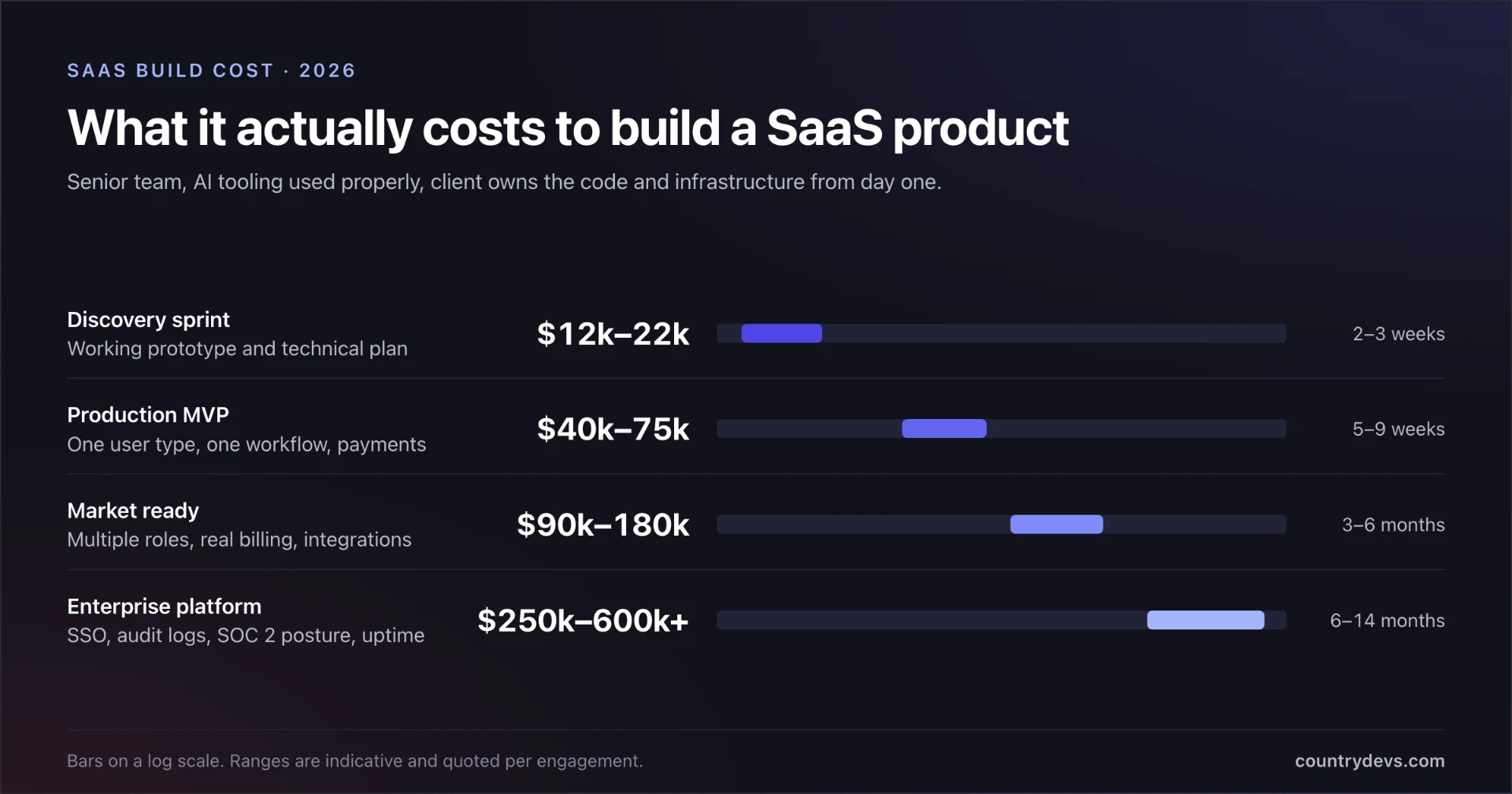
In 2026, built by a senior team using AI tooling properly, a SaaS product costs roughly this much:
What you are building | Realistic range | Time |
|---|---|---|
Discovery sprint, working prototype, technical plan | $12,000 to $22,000 | 2 to 3 weeks |
Production MVP, one user type, one core workflow, real payments | $40,000 to $75,000 | 5 to 9 weeks |
Market ready product, multiple roles, real billing, integrations | $90,000 to $180,000 | 3 to 6 months |
Enterprise platform, SSO, audit logs, SOC 2 posture, uptime commitments | $250,000 to $600,000 plus | 6 to 14 months |
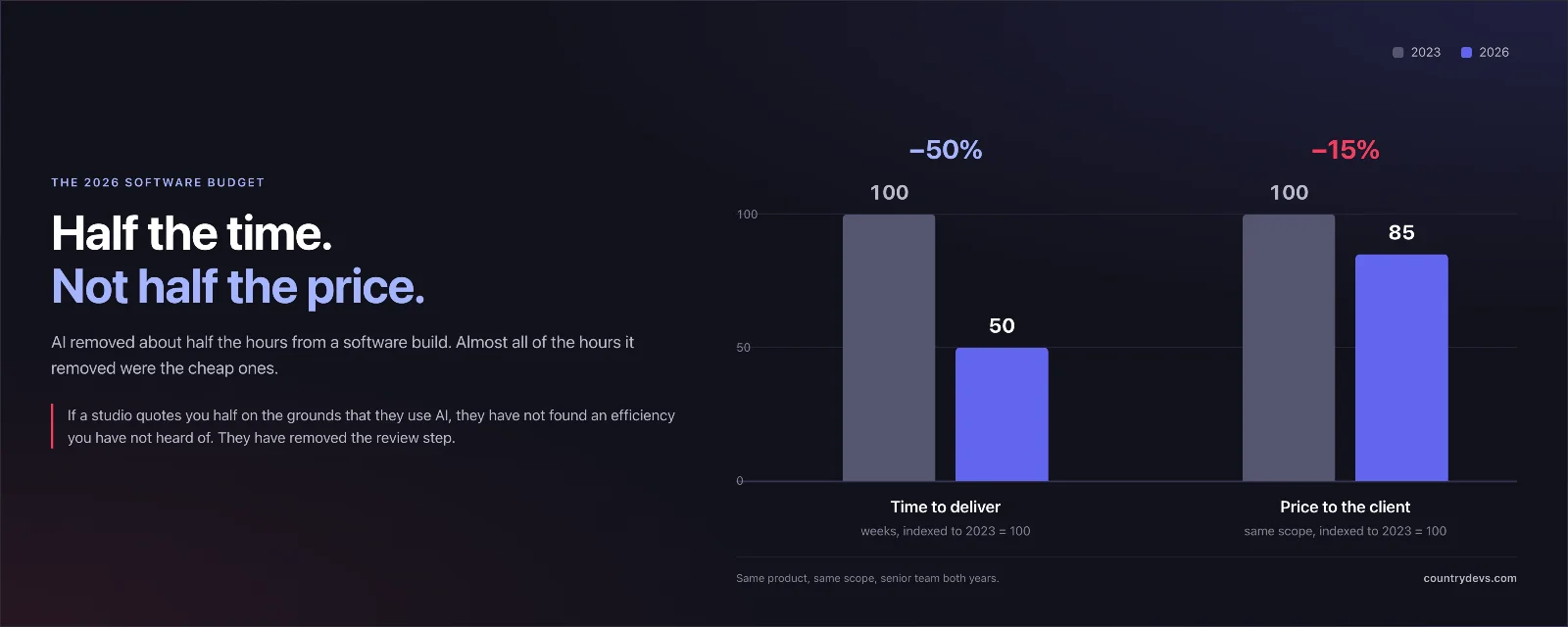
Compare those against the same table two years ago and something will surprise you. The timelines roughly halved. The prices came down by ten to twenty percent.
That gap is the most useful thing on this page, and the rest of the article is an explanation of it. The short version: AI removed about half the hours from a software build, and almost all of the hours it removed were the cheap ones. What remains is disproportionately made of senior judgement, review and other people's approval processes, none of which got faster.
If a studio quotes you half of the table above on the grounds that they use AI, they have not found an efficiency you have not heard of. They have removed the review step. You will not see the difference for about ninety days.
The four things that set the number
Before the AI discussion, the drivers, because they matter more than any of it. The number is not driven by how many features you list. It is driven by four things:
How many kinds of user your product has. The largest single driver and the one founders never mention on a first call.
Whether money moves through it. The step from displaying information to taking recurring payments is large and permanent.
How many outside systems it must talk to. Each is a small project with someone else's timeline attached.
Who your customers are. Enterprise buyers bring a compliance burden that is immune to every advance of the last three years.
A product with forty features and one user type is cheaper than a product with twelve features, three user types, usage based billing and a Salesforce integration. Almost every founder surprised by a quote was surprised by one of those four. Each gets a section below.
Half the time, not half the price
We use Claude Code and similar tooling every day, on every project. This is not a studio grudgingly acknowledging a trend. Output per engineer is genuinely a multiple of 2023, and any studio quoting 2023 timelines in 2026 is charging you for a difficulty that no longer exists.
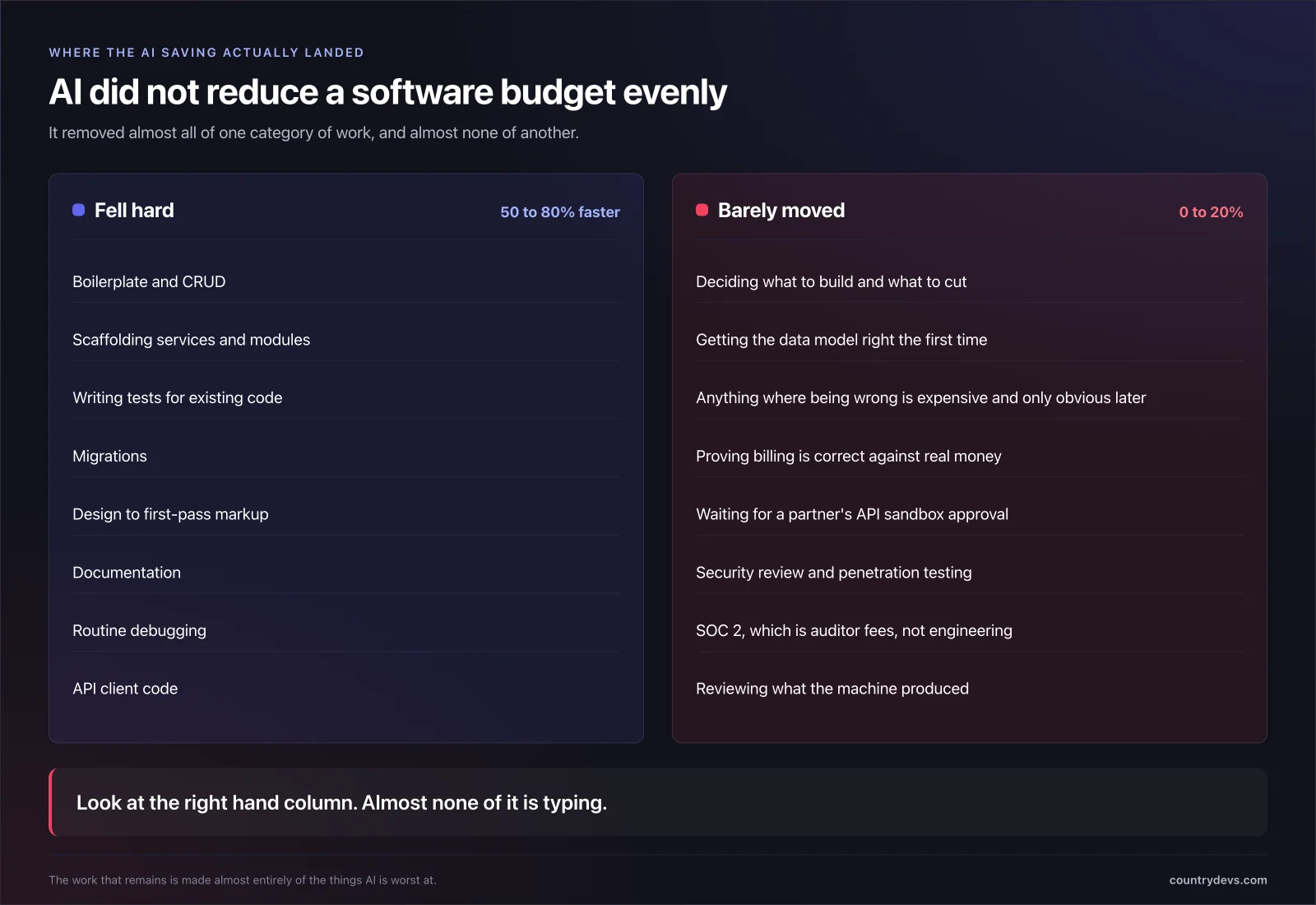
But the saving did not arrive where people assume. Here is the split.
Fell hard, 50 to 80 percent faster | Barely moved, 0 to 20 percent |
|---|---|
Boilerplate and CRUD | Deciding what to build and what to cut |
Scaffolding services and modules | Getting the data model right the first time |
Writing tests for existing code | Anything where being wrong is expensive and only obvious later |
Migrations | Proving billing is correct against real money |
Design to first-pass markup | Waiting for a partner's API sandbox approval |
Documentation | Security review and penetration testing |
Routine debugging | SOC 2, which is auditor fees, not engineering |
API client code | Reviewing what the machine produced |
Look at the right hand column. Almost none of it is typing.
Two years ago the left column was most of a build. Today it is a minority, which means the work that remains is made almost entirely of the things AI is worst at. That is why the hours halved and the price did not.
So where did the efficiency actually go? Three places, and they are the reason to hire a studio rather than a subscription.
Into your calendar. You get the same product in half the elapsed time. For a company trying to reach a market before someone else does, that is worth considerably more than a discount.
Into review. This is the one nobody advertises. When a machine produces a large volume of plausible code very quickly, the constraint becomes how fast a competent senior engineer can confirm it is correct. Our QA and code review budget went up as a share of every project, from roughly 10 to 15 percent to 16 to 22 percent. That is not overhead. That is the entire difference between a product and a liability.
Into things that used to get skipped. Test coverage, documentation, accessibility, proper error handling, the audit log. These were always the first casualties of a tight budget. They are now cheap enough that there is no excuse, and we build them in by default rather than quoting them as extras.
There is also a new line that did not exist in 2023. AI tooling at professional usage runs roughly $150 to $400 per engineer per month across subscriptions and token spend, higher on agent-heavy work. Small against what it replaces, not zero, and any studio claiming their tooling is free has not looked at their own invoices.
The thing this does not change
Cheap generation is not the same as cheap software. The bottleneck moved. It did not disappear.
You can now produce a working application for the price of a subscription. That is real and I will not argue with anyone who says otherwise. What you cannot yet produce for the price of a subscription is the judgement about which of the model's confident, plausible, immediately working suggestions will cost you a quarter in eighteen months. The model will give you a schema with one user, one tenant and one role, because you asked for something that works and that works. It has no way of knowing your customers will turn out to be teams.
That is the product a studio sells in 2026. Not typing, and not even code. The specific knowledge of which decisions are load bearing, applied early enough to still be cheap.
The practical framing: use AI to get to version one, and pay for senior judgement at the points where a wrong answer compounds. Those points are fewer than a studio would like you to believe and far more numerous than a subscription will handle.
1. How many kinds of user does your product have?
One user type means one set of screens, one permission model, one onboarding flow, one set of emails, one thing to test. Add an admin. Now you have a second application living inside the first, with its own screens, permissions and edge cases. Add an organisation owner who can invite team members and control what they see. Now you have invitations, seat management, role changes, what happens when the owner leaves, and what a half-invited user sees when they click an expired link.
AI helps with the screens. It does not help with the twenty decisions in that paragraph, and it will invent an answer to each of them if you do not supply one.
A rough multiplier from our own projects: the second user type adds around 35 percent to the build, and the third adds around 25 percent on top. Those came down slightly as generation got cheaper. They did not go away, because most of that cost was never typing.
The advice is not "have fewer user types". Some products genuinely need three. The advice is to say it in the first sentence of your brief, because a quote built for one user type against a product that needs three is the most common reason a project runs over.
2. Does money move through it?
The least AI-compressible area of a normal SaaS build.
Taking a single one-off payment is now genuinely an afternoon. That is not what SaaS means. SaaS billing means subscriptions: plan changes mid-cycle, proration, failed payments, dunning, expired cards, refunds, upgrades that apply immediately and downgrades that apply at period end, annual plans, discount codes, tax that varies by the customer's country, and invoices a finance department will accept.
An AI will write all of that quickly and convincingly. Verifying it is correct is the work, and verification did not get cheaper, because the failure mode is the hardest category of bug there is: the one where the customer's bank statement and your database disagree.
We budget $7,000 to $18,000 for subscription billing done properly, against $8,000 to $20,000 two years ago. Note how little that fell relative to the timeline. That is not an accident, it is the whole thesis of this article in one line item. Add more for usage based pricing, where you also need metering you can defend when a customer disputes their bill.
3. How many systems must it talk to?
Every integration is a small project with its own authentication, rate limits, outages, failure modes and forced version upgrades.
Our working figures:
A well documented, modern REST API with good SDKs: $1,500 to $4,000. This category fell furthest of anything in the article, because it is mostly client code and AI writes client code extremely well.
An older enterprise system, or anything requiring a sandbox account and partner approval: $8,000 to $22,000, and expect the approval to take longer than the code. It always did. Now it takes very much longer than the code.
Anything involving a bank, an insurer, a government portal or a healthcare record system: budget separately and do not promise a launch date until you have credentials in hand.
The trap here is the calendar, not the cost. Three quarters of the integration delays I have seen were waiting for someone else's approval. AI made our side faster and did nothing to theirs, which means integration wait time is now a much larger share of a project's elapsed time than it used to be. Raise it in week one.
4. Who are your customers?
If you sell to consumers or small businesses, your compliance burden is mostly privacy law and sensible security.
If you sell to enterprises, procurement will send a security questionnaire asking for single sign-on, audit logging, role based access control, data retention policies, an incident response process, a subprocessor list and increasingly a SOC 2 Type II report.
First year SOC 2 still runs around $20,000 to $35,000 for a small company, and that number did not move at all, because it is auditor fees and observation windows rather than engineering. A first Type II report still realistically takes six to twelve months.
That is the cleanest illustration of this entire article. If your product needs enterprise compliance, a meaningful part of your budget is completely immune to every advance of the last three years, and its share of your total has gone up, purely because everything around it got cheaper.
The engineering side of compliance is dramatically cheaper designed in than retrofitted. Selling to enterprise within eighteen months? Build the audit log and the role model from the start, defer the certification. Cheap on day one, expensive on day four hundred.
Where the money goes now
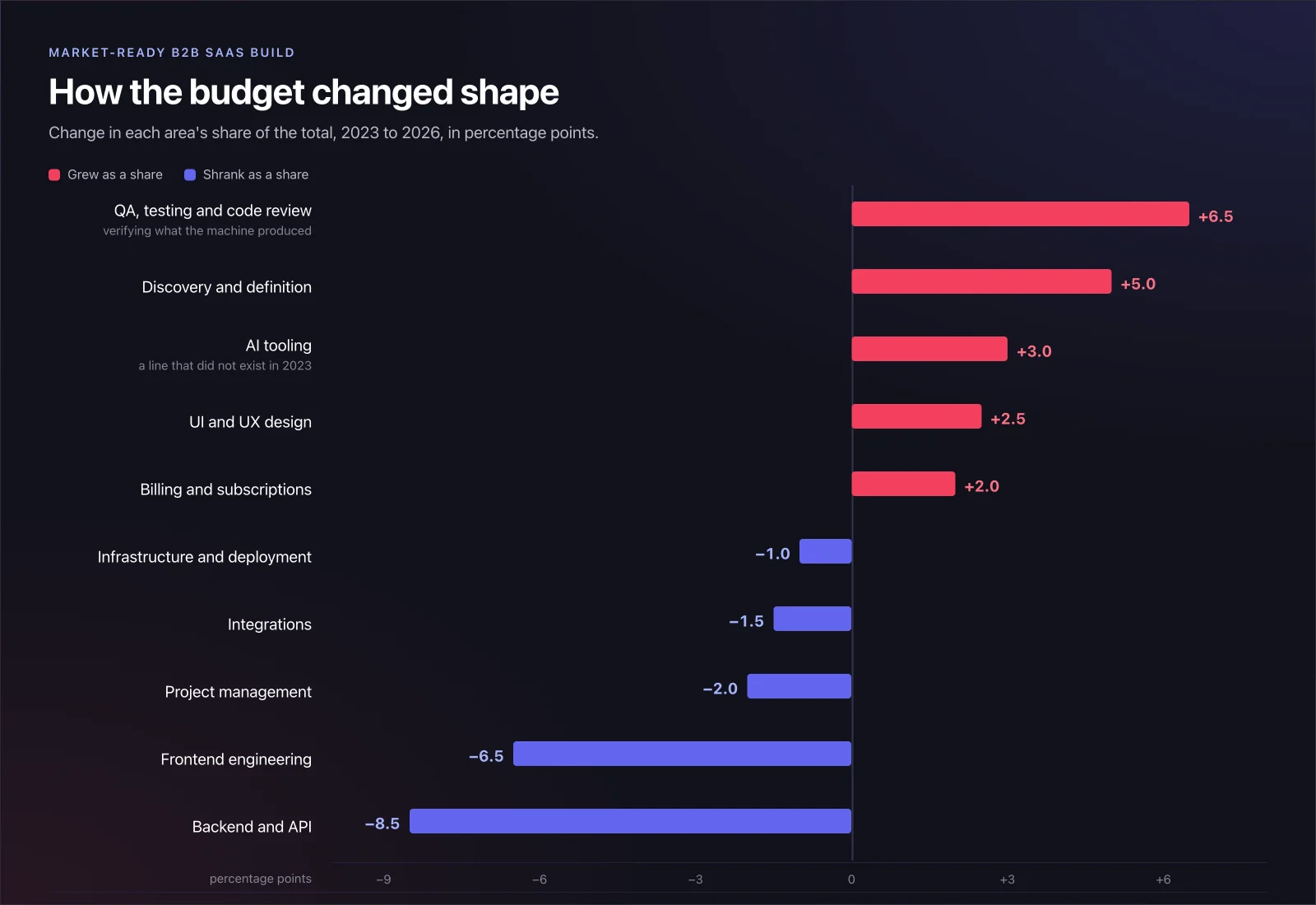
The breakdown on a market ready B2B SaaS build, the $90,000 to $180,000 band. The 2023 shares are included because the change in shape says more than any single number.
Area | Share, 2023 | Share, 2026 | What it covers |
|---|---|---|---|
Discovery and product definition | 5 to 10% | 10 to 15% | Working out what to build and, more usefully, what not to |
UI and UX design | 10 to 15% | 12 to 18% | Flows, screens, design system, not decoration |
Frontend engineering | 20 to 25% | 14 to 18% | The application the user touches |
Backend and API | 25 to 30% | 16 to 22% | Data model, business logic, permissions, jobs |
Billing and subscriptions | 8 to 12% | 10 to 14% | Everything in section 2 above |
Integrations | 5 to 15% | 5 to 12% | Highly variable, see section 3 |
Infrastructure and deployment | 5 to 8% | 4 to 7% | Environments, CI, monitoring, backups |
QA, testing and code review | 10 to 15% | 16 to 22% | Including verifying everything the machine produced |
AI tooling | 0% | 2 to 4% | Subscriptions and token usage |
Project management | 8 to 10% | 6 to 8% | Should be this and not more |
Three things worth staring at.
Writing code is no longer the largest line. Frontend and backend together fell from roughly half the budget to roughly a third.
Review and QA is now larger than either engineering line. A studio that has not increased its review share is not passing you a saving, it is passing you a risk.
Discovery went up. Not because it costs more, but because getting the definition wrong is proportionally more expensive when building the wrong thing takes three weeks instead of three months. You can now build the wrong product faster than ever.
How we staff it, and what a team costs monthly
Fixed-scope project pricing suits a defined build. Companies with a roadmap rather than a project usually want a team, so here is that pricing too.
A senior squad is four to five people: a lead engineer or architect, two senior engineers, a designer, and QA and project management shared across the squad. That runs $28,000 to $45,000 per month, depending on composition and how much design the phase needs.
Two things I would want a buyer to know about how we staff.
We run small senior teams, not large mixed ones. The old economics rewarded throwing bodies at a problem, because output scaled roughly with headcount. That is no longer true. Three seniors with modern tooling outproduce eight mixed engineers and produce far less that has to be reviewed twice. Our teams got smaller and more expensive per head over the last two years, and total project cost still came down.
The people you meet are the people who build it. Named in the contract, with a notice requirement before anyone is substituted. The classic offshore failure is a rate quoted against seniors and a project staffed with juniors from month two, and it is worse now than it used to be, because a junior with an AI assistant produces a great deal of confident code very quickly. Volume of output is no longer any evidence of progress at all.
For programmes beyond the enterprise band above, and they exist, we quote per engagement against an MSA rather than from a table.
What the geography actually changes
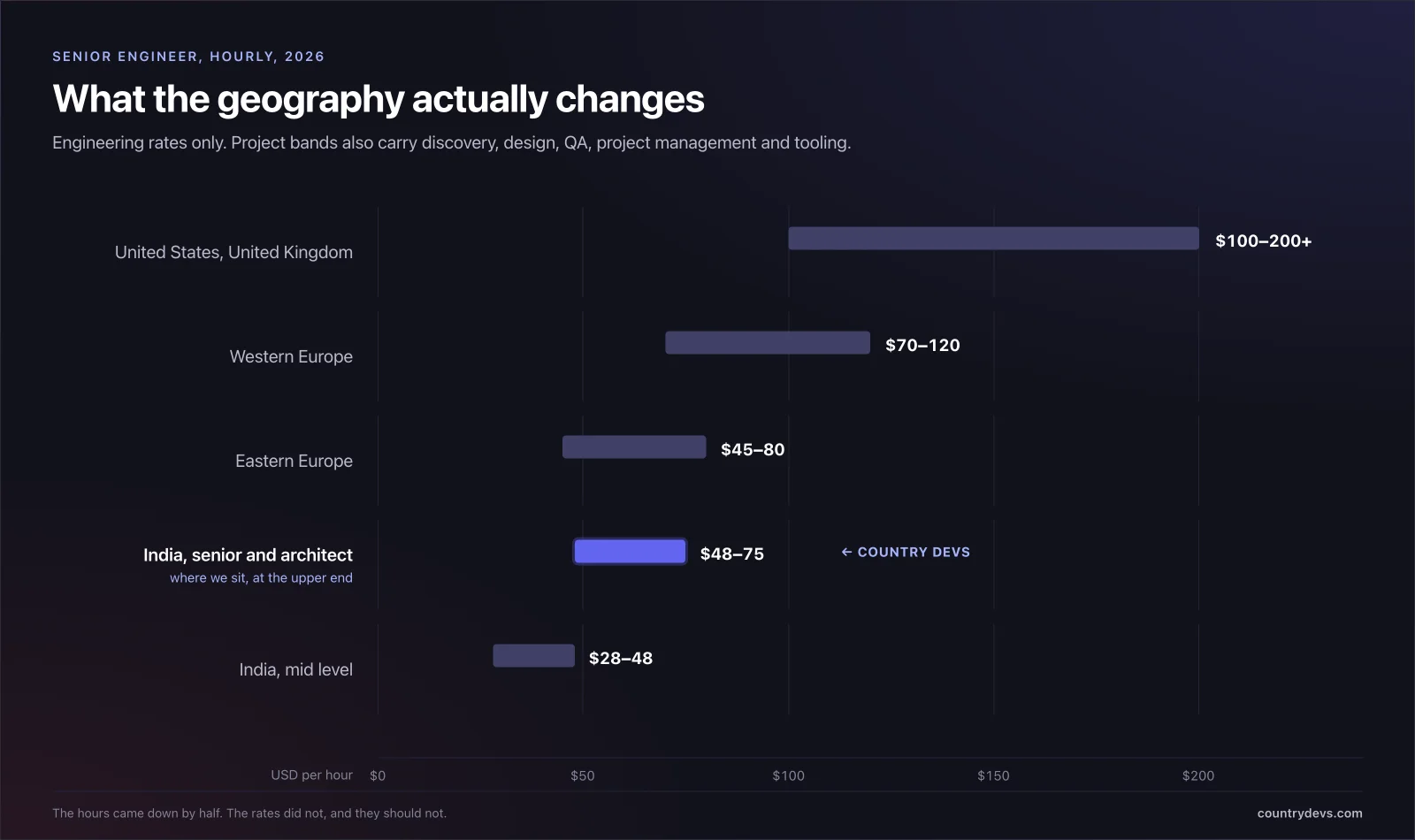
For founders in the US, the UK and Europe weighing local against offshore, here are engineering rates without the marketing.
Region | Senior engineer, hourly | Notional 700 hour MVP, engineering only |
|---|---|---|
United States, United Kingdom | $100 to $200+ | $70,000 to $140,000 |
Western Europe | $70 to $120 | $49,000 to $84,000 |
Eastern Europe | $45 to $80 | $31,500 to $56,000 |
India, senior and architect level | $48 to $75 | $33,600 to $52,500 |
India, mid level | $28 to $48 | $19,600 to $33,600 |
Two clarifications, because this table is often misread.
It is engineering hours only. The project bands at the top of this article include discovery, design, QA, project management and tooling, which is why an MVP is $40,000 to $75,000 rather than the engineering line alone.
We sit at the upper end of the India band and we intend to. We are not the cheapest quote you will receive and we are not trying to be. Senior judgement is the scarce input in 2026 and scarce inputs do not get cheaper. The hours came down by half. The rates did not, and I would treat anyone promising otherwise with real suspicion.
The saving against a US or UK team is genuine, typically 45 to 60 percent for equivalent seniority. It is also a smaller cheque than it used to be, simply because the totals are lower, which makes rate a weaker reason to work with an offshore studio than it was five years ago and everything else a stronger one.
The costs that come after launch
The build is the down payment, and this is the section AI changed least.
Infrastructure. $200 to $500 a month early on, rising to $1,000 to $5,000 as you grow. Higher if you run your own model inference, which is now a common line and can dwarf everything else if you are careless with it.
Third party services. Error tracking, email delivery, analytics, logging, authentication, background jobs, a status page. Individually cheap, collectively $300 to $1,500 a month, universally forgotten in the original budget.
AI tooling for whoever maintains it. $150 to $400 per engineer per month, ongoing.
Maintenance. Plan on 15 to 20 percent of the original build cost per year, down slightly from 15 to 25. It fell because dependency upgrades, security patches and routine fixes are genuinely faster. It did not fall further because the expensive part of maintenance was never the fixing, it was the noticing.
Version two. Which is the point of the whole exercise. Everything you learn in the first six months of real usage will make you want to change something structural. The best predictor of whether that is affordable is whether the original build has tests and a coherent architecture. That is what you are actually buying when you pay for quality engineering, and it is why the cheapest quote is still so often the most expensive outcome.
So what should you actually spend?
The honest advice, in the order I would give it on a call.
If you have not validated the idea, do not hire a studio. Build it yourself with an AI tool over a weekend and take it to twenty potential customers. This advice is stronger than it was two years ago and I give it more often now, even though it costs us work. The most valuable thing we do for some clients is talk them out of a build for another quarter.
If you are validated but unsure what to build, buy the discovery sprint. $12,000 to $22,000 for two to three weeks: the product defined, the architecture decided, a working prototype, and a fixed quote for the build. Clients who skip this are the ones whose projects run over, and the cost of it is roughly what one month of the wrong direction costs.
If you have validation and no revenue, build the smallest thing that can charge money. One user type, one workflow, real payments. $40,000 to $75,000. Resist every feature not required to take the first payment. That temptation is worse than it used to be, because features are cheap to add now, and a product bloated with cheap features is still bloated.
If you have paying customers and a waiting list, build properly. $90,000 to $180,000. This is where architecture, tests and a real permissions model stop being an indulgence and become what lets you move quickly for three years.
If you are selling into enterprises, budget for compliance from the start. Not the certificate, the architecture. Audit logs, roles, data retention, SSO readiness. A few weeks now, a few months later, and the auditor's invoice is the same either way.
The question to ask instead of "how much does it cost"
I get the cost question on almost every first call, and it is the wrong question. Not because it is unreasonable, but because it cannot be answered usefully in the abstract. It is like asking what a building costs.
The question that gets a useful answer is: "For this specific outcome, by this date, what is the smallest thing you would build, and what would you deliberately leave out?"
That question is worth more now than it has ever been. When building was slow, scope discipline was enforced by the calendar. Now that anything can be built in a week, the only thing standing between you and a product nobody asked for is somebody willing to argue with you about it.
Any studio worth hiring will have opinions about what to cut. That is most of the value we provide, and very nearly all of the value that survived the last three years. If a studio answers your brief by quoting everything on it without pushing back on a single item, they are not designing your product, they are taking your order. Those are different services and only one of them is worth senior rates.