All projects
Enterprise
Clickable prototype

QKE — Quotation-to-Production System for a Commercial-Kitchen Fabricator

QKE fabricates commercial-kitchen equipment in Chennai. We are building its quotation-to-production system: the master-data slices of the real Next.js and Express app are built, and the full nine-role workflow, from quotation to stores, runs as an HTML prototype.

For Quality Kitchen Equipments (QKE)Aug–Sep 2026
  • Web app (master-data slices built)
  • Nine-role workflow prototype (HTML)
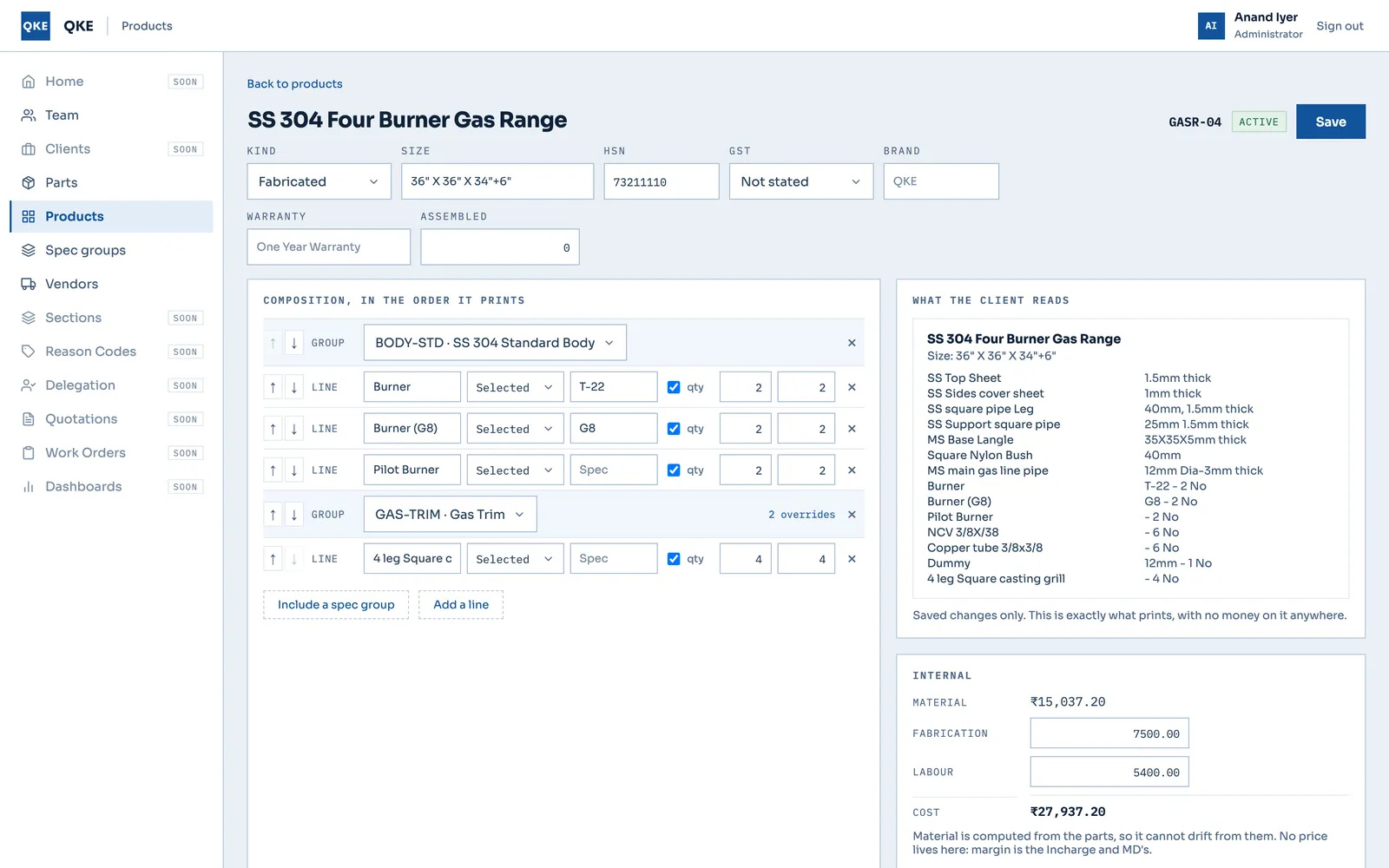
Product editor for a four-burner gas range with composition rows, a client-facing spec preview and an internal cost panel.

Overview

Quality Kitchen Equipments (QKE) is a Chennai fabricator of commercial-kitchen equipment: gas ranges and the stainless-steel tables, counters and fittings around them. Every job starts as a quotation of specified products and ends on the factory floor, with sheet, pipe and fittings bought, inspected, issued and consumed along the way.

We are building one system for that chain, with nine roles: Admin, Managing Director, Incharge, Sales, Engineer, Factory Manager, Stores Manager, Store Keeper and QC. Two things are true at once, and we say both. The real application — Next.js on the front, Express and MongoDB behind — has its foundations built and tested: invitation-only sign-in, the team panel, the role shell, and the parts, product, vendor and part-detail masters. The full workflow beyond master data, from quotation approval through work orders, buying, goods receipt, QC and stock, exists as an HTML prototype on one shared model.

The prototype is the reference the remaining slices are built against. It runs in a browser on seeded data, has its own verification suites, and has been walked through with QKE. Nothing is deployed and no one at QKE uses it for live orders yet.

The challenge

A fabricated product is not a price-list item. A gas range is a standard steel body, a gas trim and a few counted parts like burners, and a one-burner and a three-burner range share the same body, with only the burner-side counts changing. QKE's quotations print quality statements ("1.5 mm top sheet") rather than weights, yet the business still needs to know what each product costs to make and what to buy when an order lands.

The buying side has its own traps. Sheet and pipe come in whole stock units, the same part is bought at different rates over time, and a quotation passes through an engineer, the Incharge and the MD before sales can release a work order. A system that treats products as SKUs with a fixed price, or stock as one average rate, gets all of this wrong.
The solution

We modelled the product from QKE's own documents. A product is never a priced SKU: it is a spec sheet composed from reusable spec groups and parts, and its material cost falls out of the parts it consumes. What prints for the client (a label, a spec, a count where something is countable) is kept separate from the internal quantity used for costing. Correcting a shared spec group fixes every product that uses it, and the margin lives on the quotation, not the product. Money is integer paise everywhere, including on the wire.

The prototype carries one quotation from the engineer to the Incharge, the MD and sales, then on to work-order release. From there it nets the requirement against stock and rounds it up to whole sheets with the over-buy shown, runs an RFQ desk with simulated vendor mail, raises the PO, gates goods receipt through QC, holds stock as FIFO batches with their own rates, and keeps a rate book of catalogue against paid. We build the real app one role-complete slice at a time, data before the screens that read it.

The impact

Built and tested in the real app: nine slices, from invitation-only sign-in to the product-kinds model, each with its own test battery — API checks, scripted browser click-throughs, or both. In the prototype: all nine roles on one shared model, with 389 passing verification checks at the last tracker entry. After walking through it, QKE asked for four additions — revision history, spec visibility for the client, the supplied brand carried through stores, and a quotation email for Gmail — and all four went in.

The product model was first worked out against the 243 spec lines on one of QKE's real quotations, then tested against a second real quotation of 77 lines. It held: the products composed line for line, and the test exposed five additions, four of which shipped the same day. Our own reviews also caught mistakes the tests missed, such as a seeded final price three times its quote that 46 passing assertions had not questioned.

Features

What we built into QKE

Products as recipes, not SKUs

A product's spec sheet and material cost are composed from reusable spec groups and parts, so one correction to a shared group updates every product that uses it.

Print count and cost quantity kept apart

Each spec line has a count that prints (or none, for a sheet) and a separate internal quantity used only for costing, matching how QKE's quotations actually read.

Product kinds for real line types

Products are fabricated, bought-in or a service. Services such as installation carry SAC codes rather than HSN and have no parts, so the model can warn about an unfinished product without falsely warning about a service.

Engineer-to-MD quotation approval

The engineer composes a quotation from catalogue products with no prices shown; the Incharge sets a margin per kind of line — fabricated, bought-in or service — and the MD gives final sign-off before sales releases a work order.

Buying in whole sheets

The work order's requirement is netted against stock and rounded up to whole stock units, with the over-buy shown, before it goes to the RFQ desk.

RFQ desk with simulated vendor mail

RFQs go out to the vendors who supply each part; replies land unread in a departmental inbox, and approving one is the only thing that puts a price on the RFQ.

QC gate and FIFO stock

Goods receipt passes through QC, and accepted stock is held as FIFO batches with their own rates, never one average. A rate book shows catalogue and paid rates side by side.

Masters built in the real app

Parts with HSN, GST, grade, cost per stock unit and where-used; vendors with purchase history and derived performance; products and spec groups; and an Admin team panel that can assign all nine roles.

A record view for every list

In the prototype, every list has a View button that opens one modal for thirteen kinds of record, so a part's batches, rates paid, suppliers and consuming products are reachable.

By the numbers
9
Real-app slices shipped and verified (auth to product kinds)
9
Roles in the system
389
Prototype verification checks passing
243
Real quotation spec lines the product model was built against
Screens

What QKE looks like

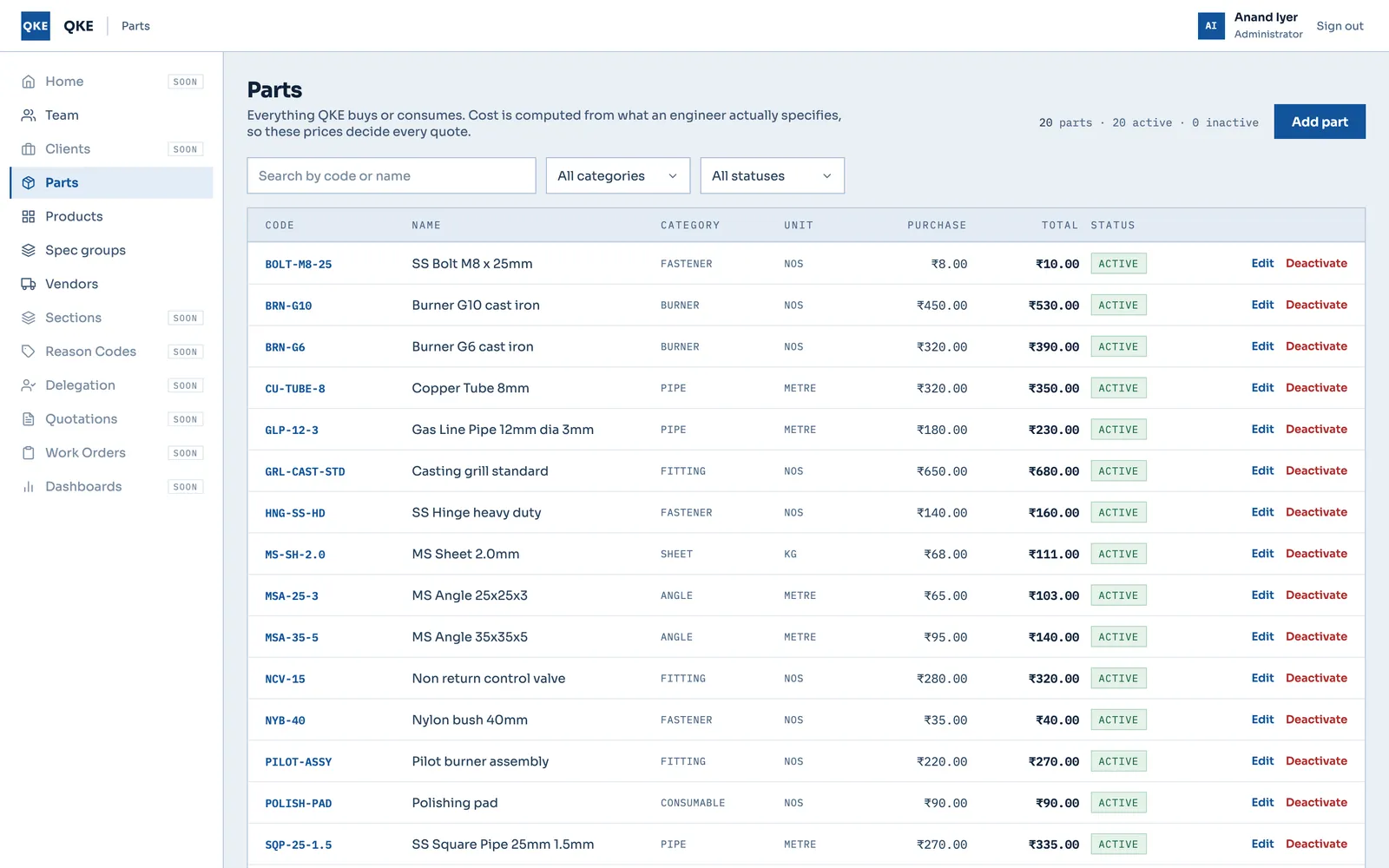
QKE Parts table listing stainless steel sheets, pipes, burners and fittings with category, unit, purchase and total prices.
The parts catalogue holds everything QKE buys or consumes, with purchase price and the fabricated total that every quotation's cost is computed from.
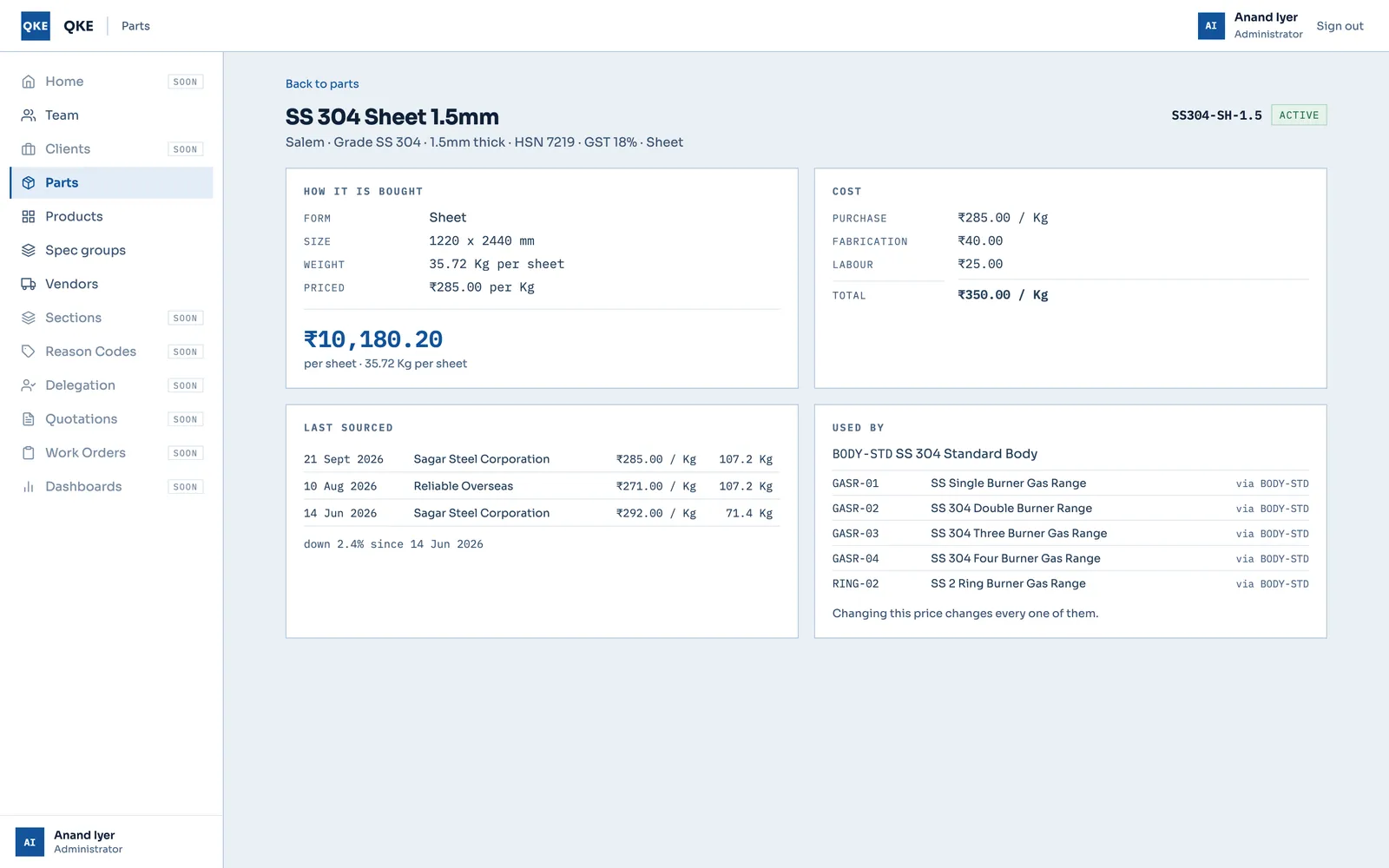
Part detail for SS 304 Sheet 1.5mm with buying form, cost breakdown, last-sourced purchases and the products using it.
A part shows how it is bought (sheet size and weight), its cost build-up, recent purchases by vendor with the price trend, and every product it feeds.
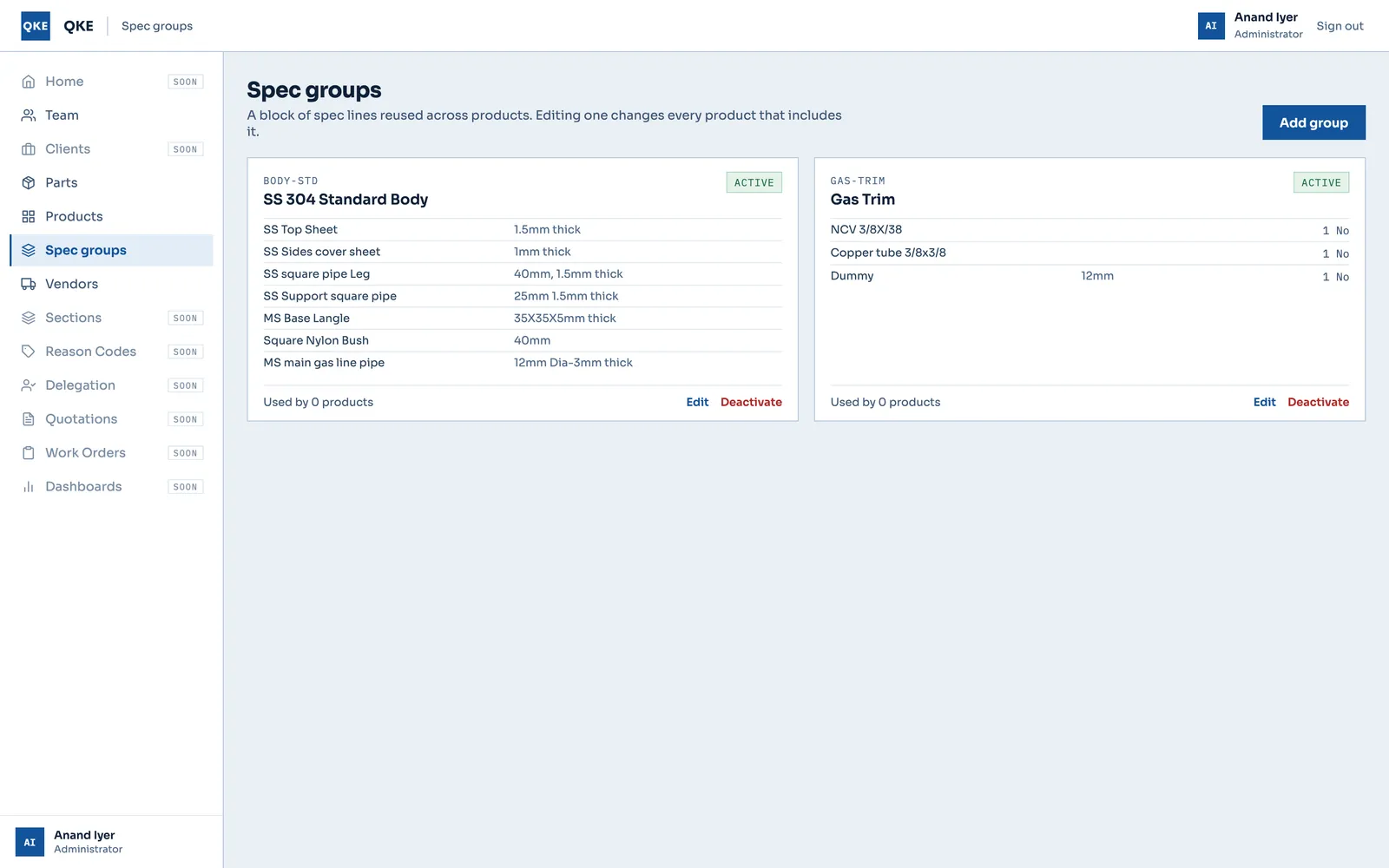
Spec groups page listing reusable groups of specification lines.
Reusable spec groups capture blocks of lines that travel together, such as the standard SS 304 body, so products reference them instead of copying them.
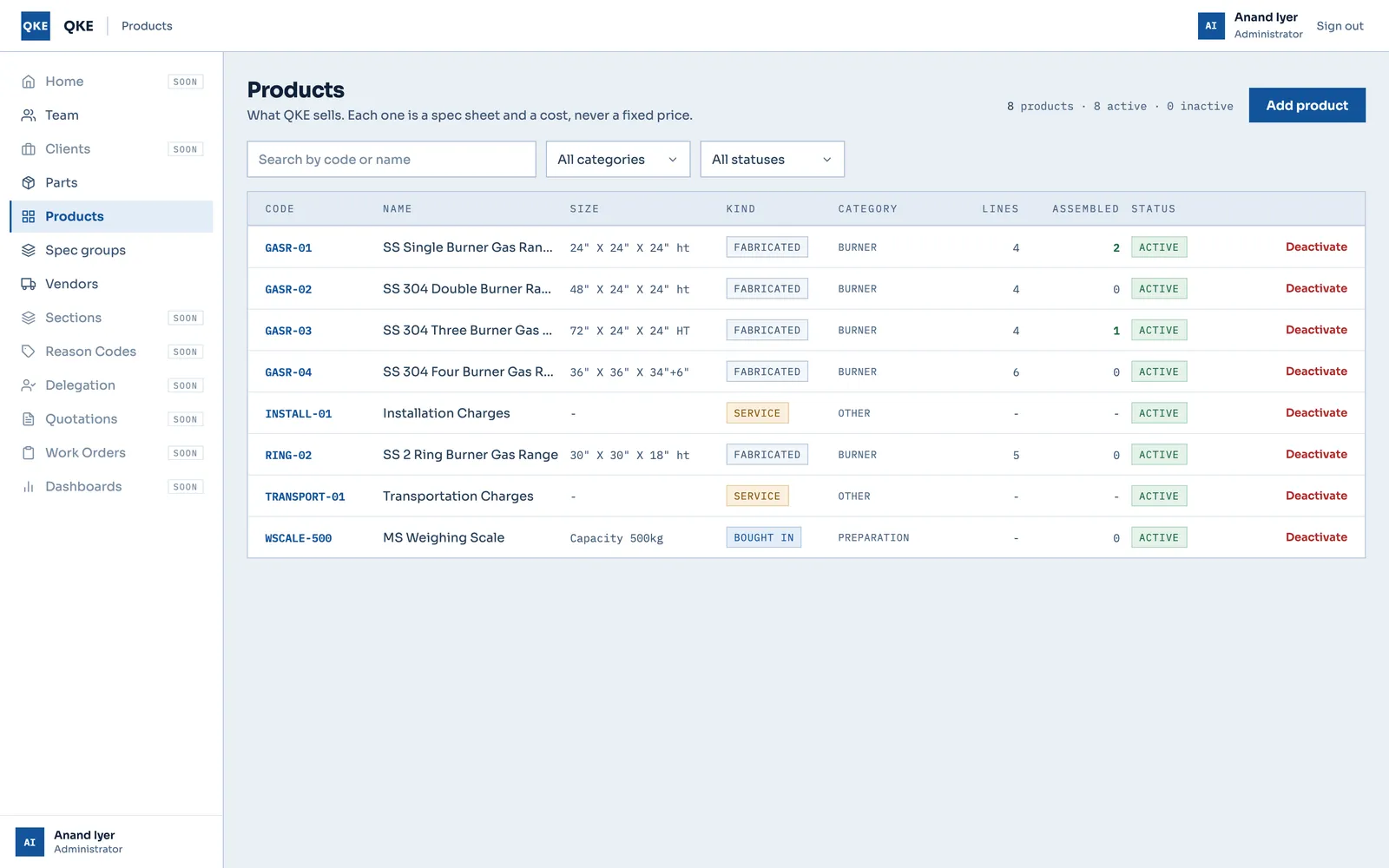
Products table with gas ranges, installation and transport services and a weighing scale, showing size, kind, line count and status.
Products are spec sheets with a computed cost rather than a fixed price, split into fabricated, bought-in and service kinds.
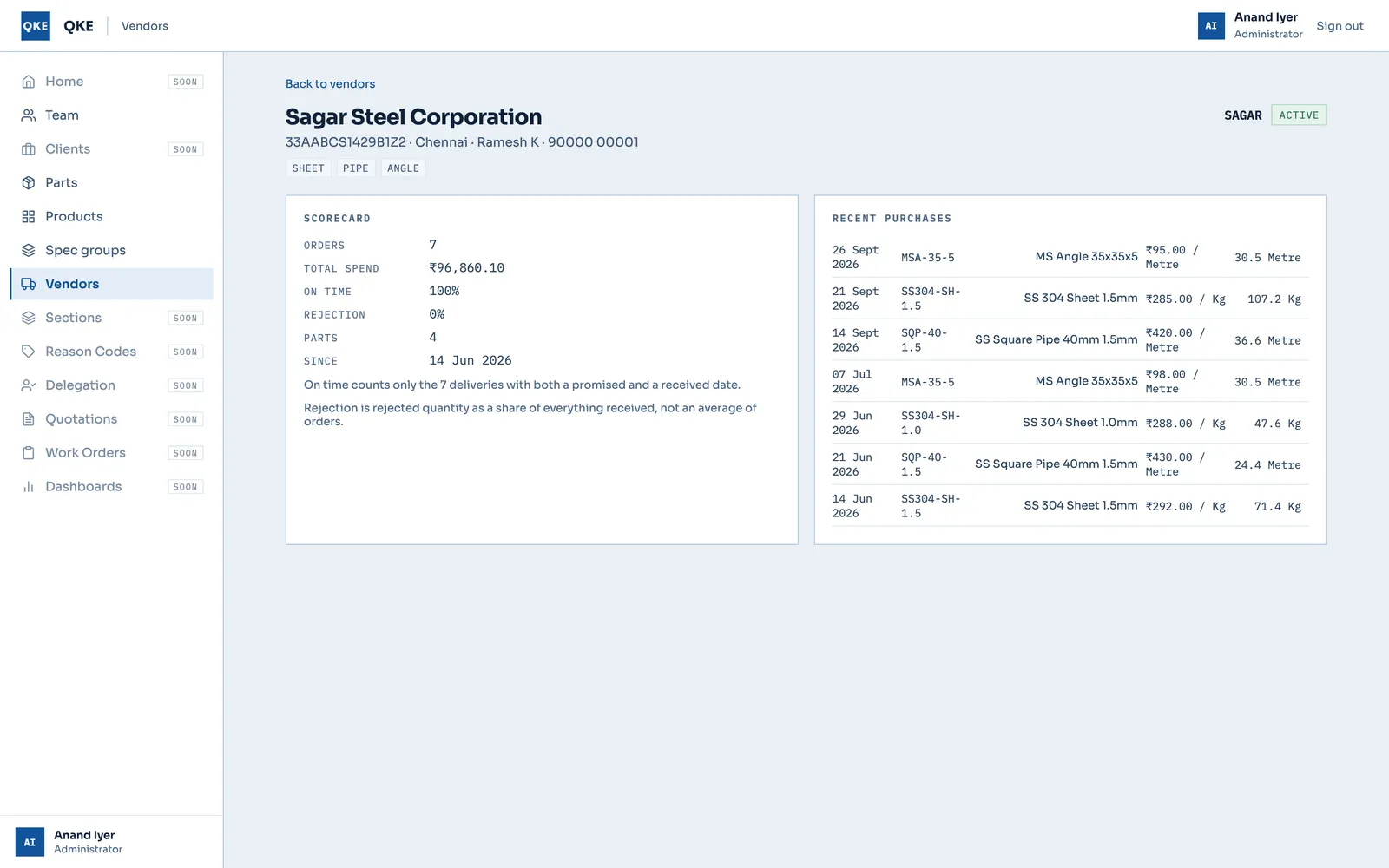
Vendor detail page with a scorecard and a list of recent purchases with rates and quantities.
Each vendor gets a scorecard computed from deliveries — orders, spend, on-time and rejection rates — beside its recent purchases.
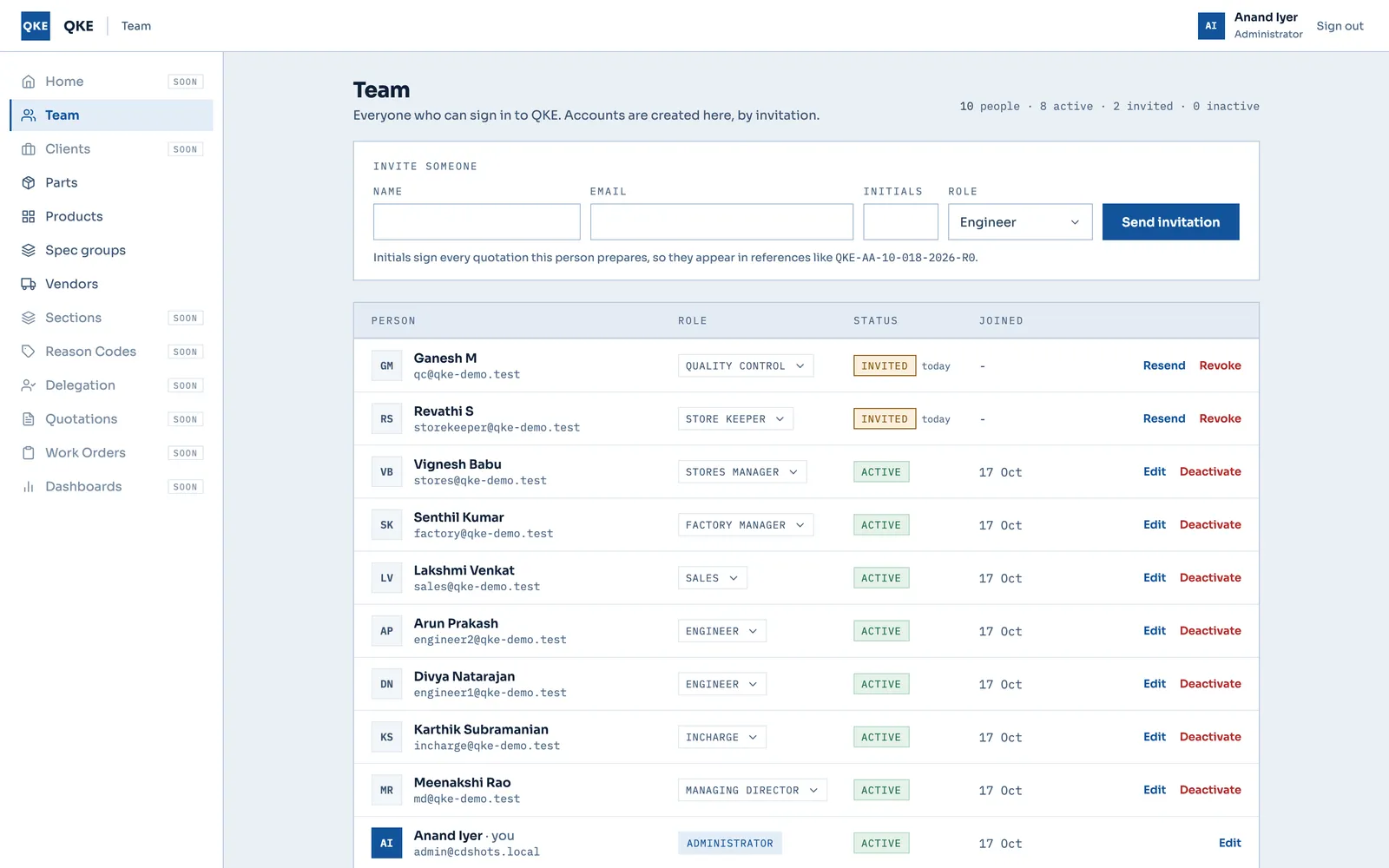
Team page with an invite form and a member list showing roles, active and invited statuses.
QKE is invitation-only: the admin invites people into nine roles, from engineer and incharge to stores, QC and factory, and their initials sign every quotation reference.
Prototype quotation builder for an invented client with product lines, cost panel, spec visibility and quotation terms.
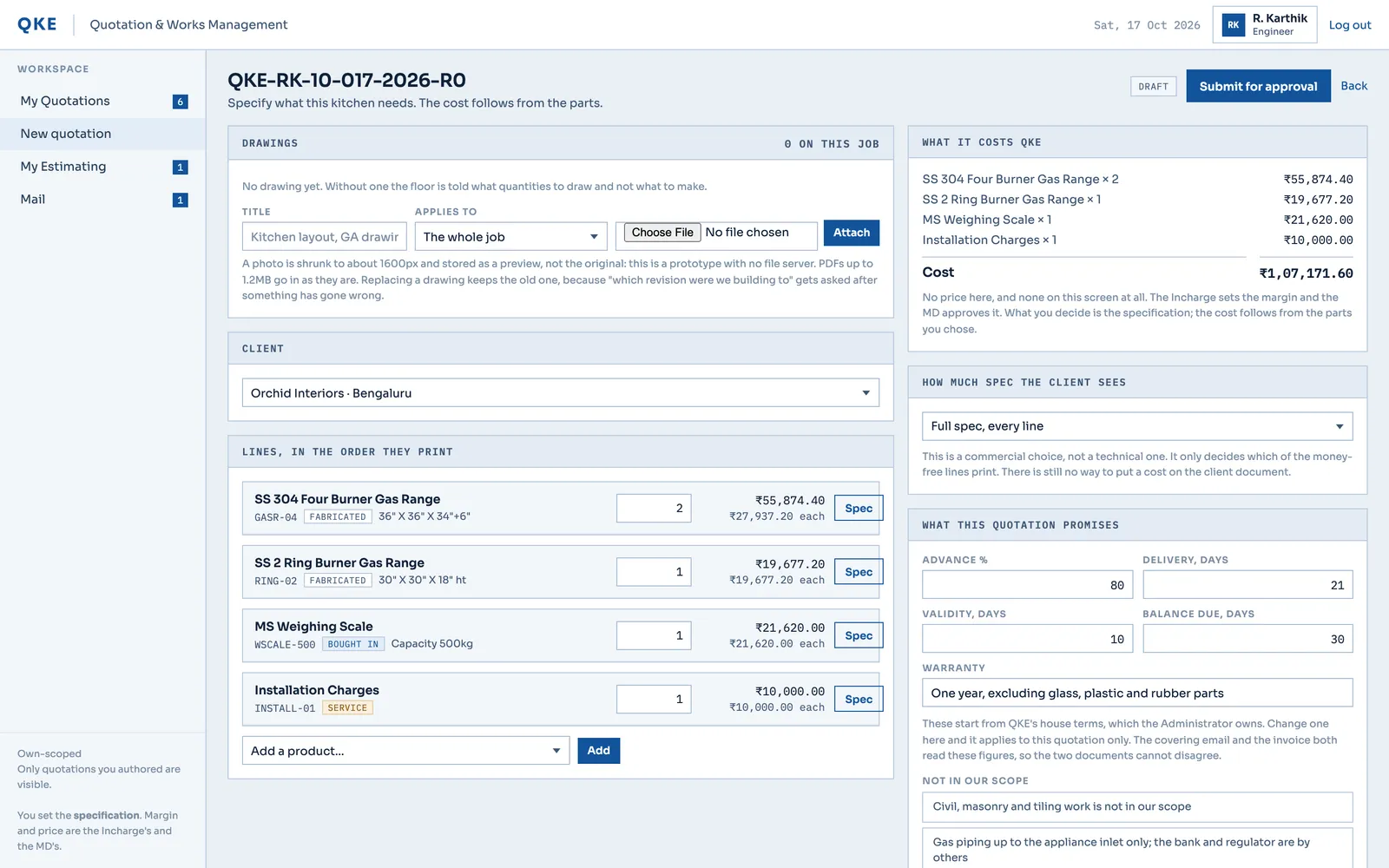
In the workflow prototype the engineer composes a quotation from catalogue products in print order; the cost follows from the parts and no price appears on the engineer's screen.
Prototype quotation approvals queue with two quotations waiting on the incharge.
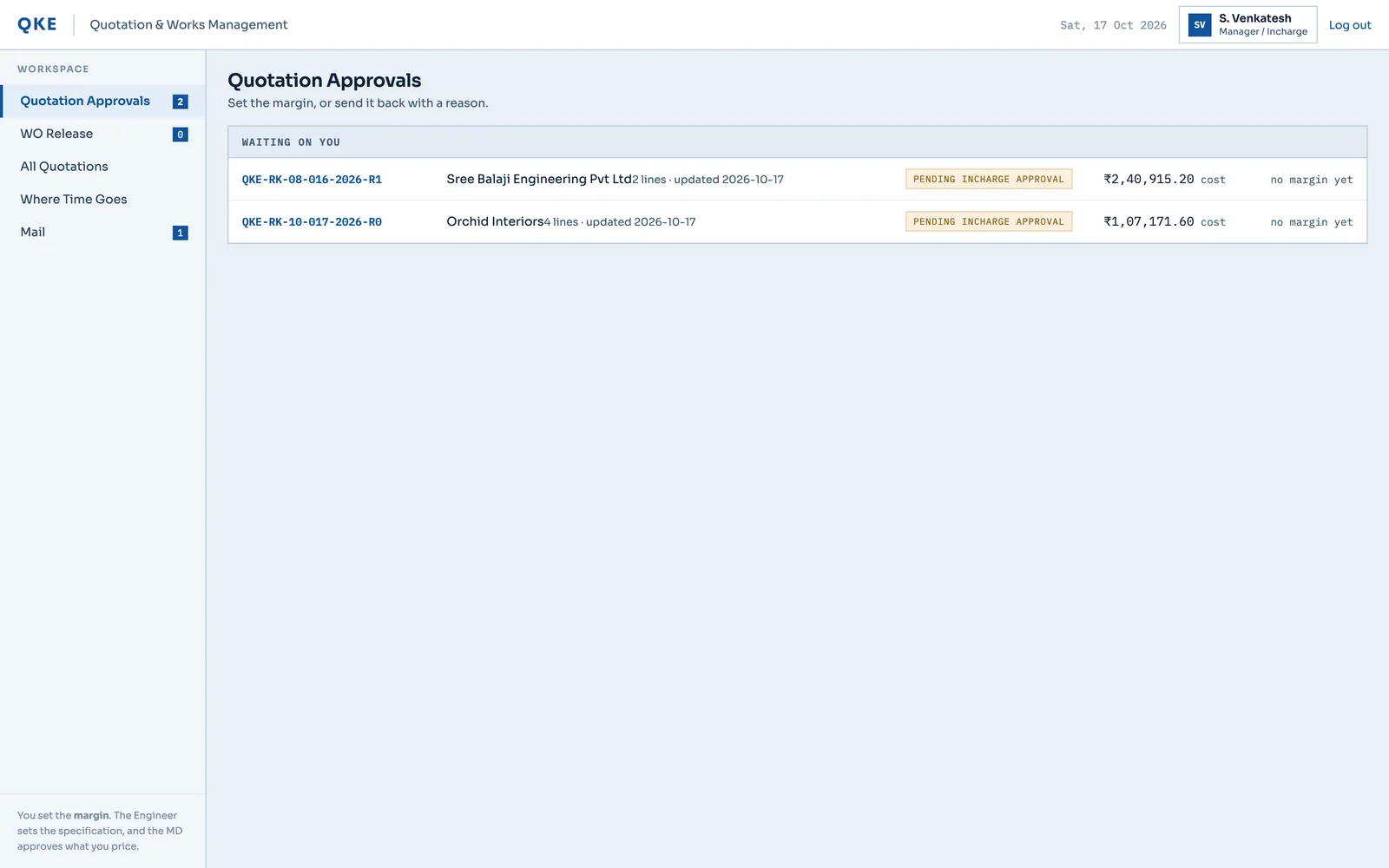
The incharge's queue holds quotations waiting for a margin; each can be priced or sent back to the engineer with a reason.
Prototype incharge pricing screen with per-kind margin inputs, cost and resulting price.
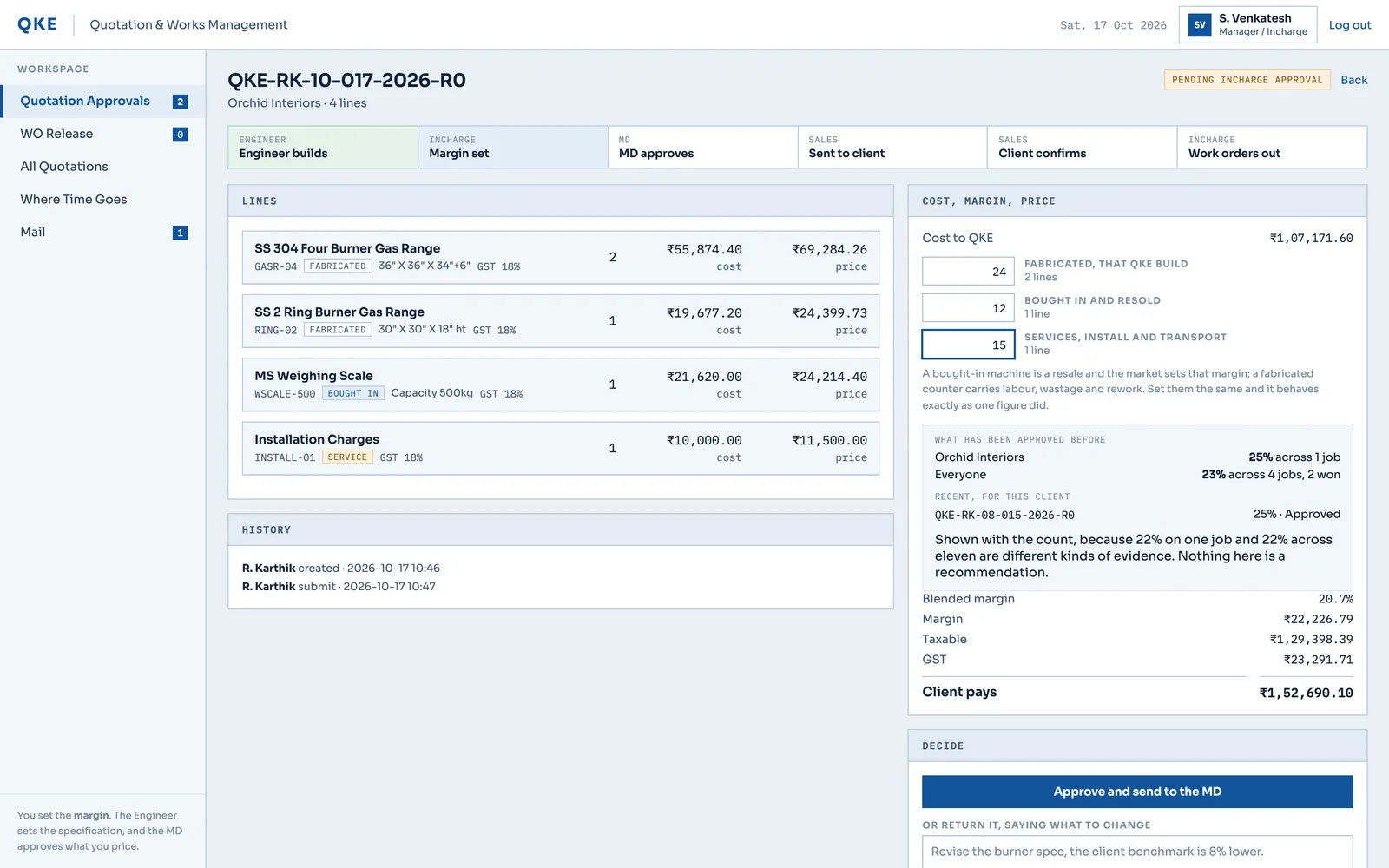
The incharge sets a margin per kind of line (fabricated, bought-in, services) and sees the resulting price beside the cost before sending it to the MD.
Prototype MD dashboard with headline figures, order book, six-week cash table and vendor spend.
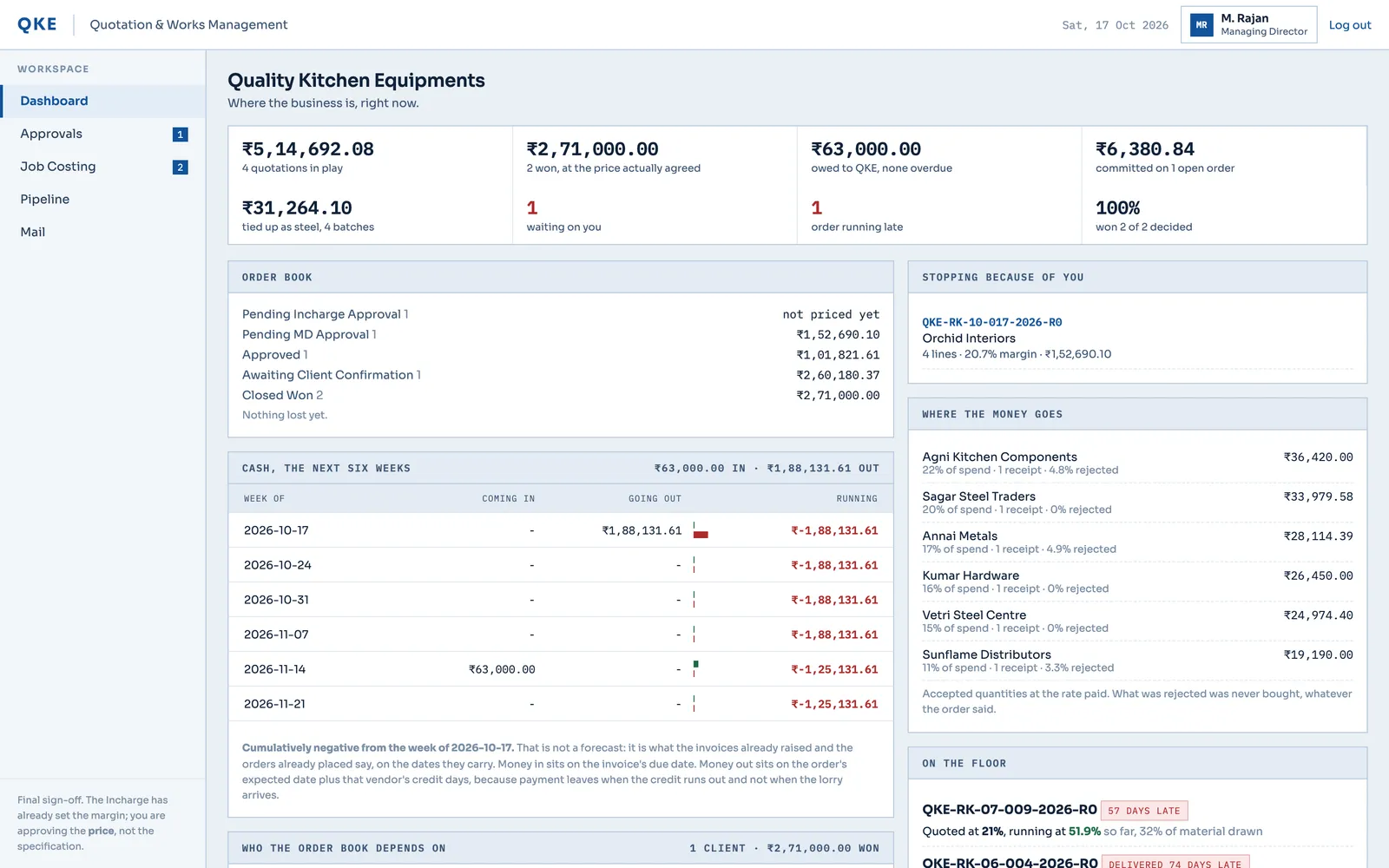
The managing director's dashboard summarises quotations in play, orders won, money owed, cash for the next six weeks, spend by vendor and jobs running late.
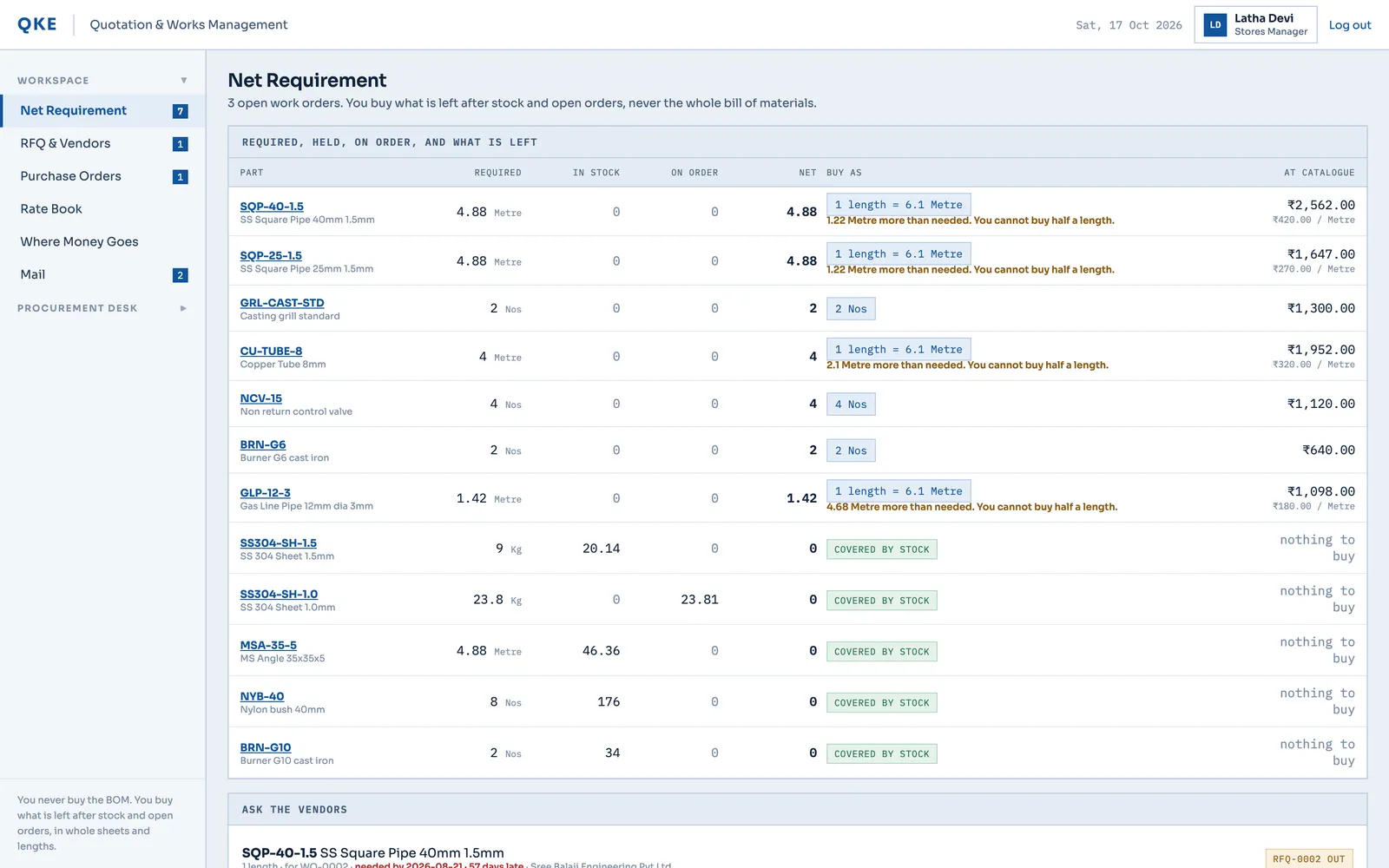
Prototype net requirement table with required, in-stock, on-order and net quantities per part.
The stores manager buys only what open work orders still need after stock and open orders, rounded up to whole sheets and lengths.
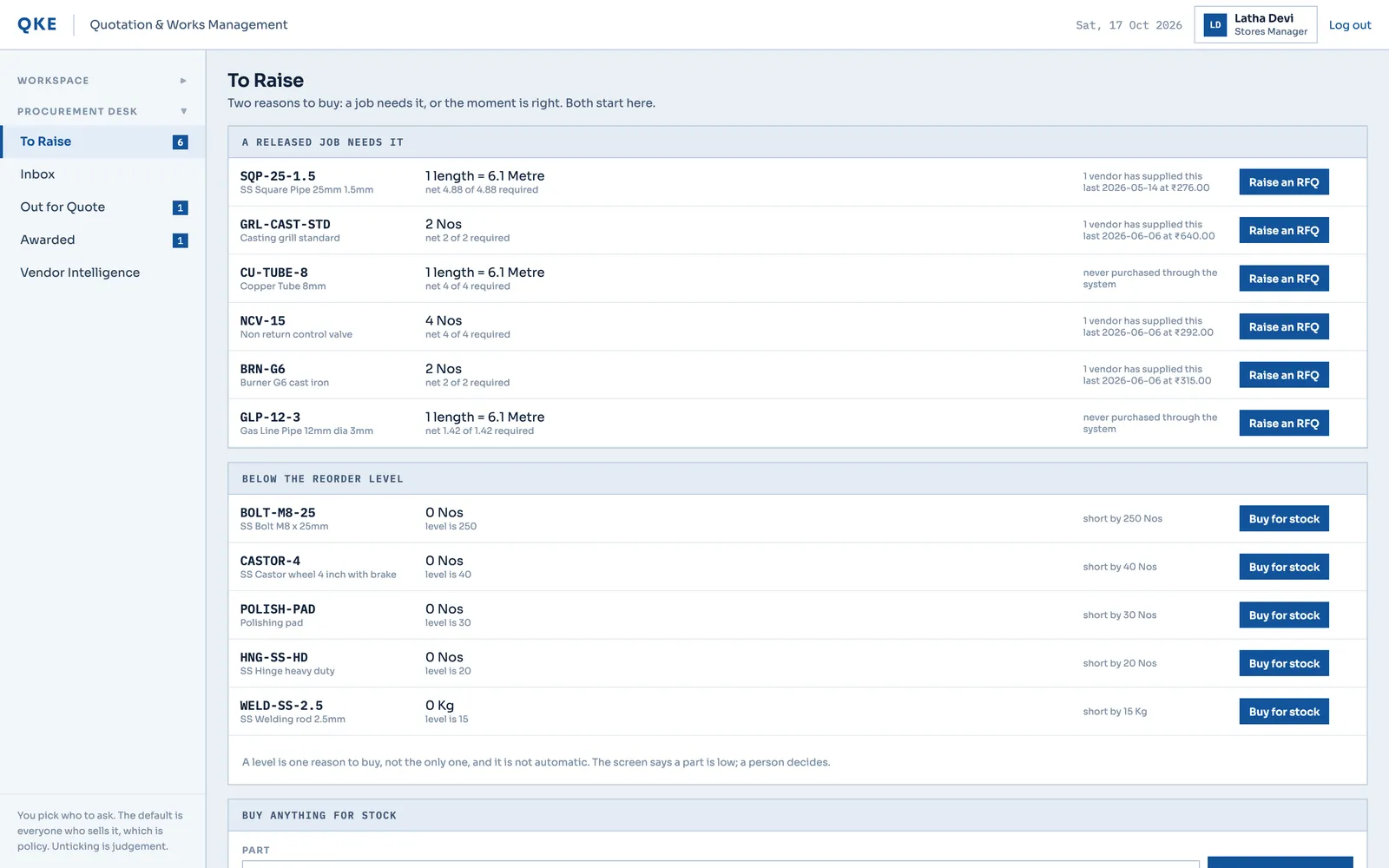
Prototype 'To Raise' list with Raise an RFQ and Buy for stock actions.
The procurement desk raises RFQs for what released jobs need and for parts below their reorder level, with each part's purchase history alongside.
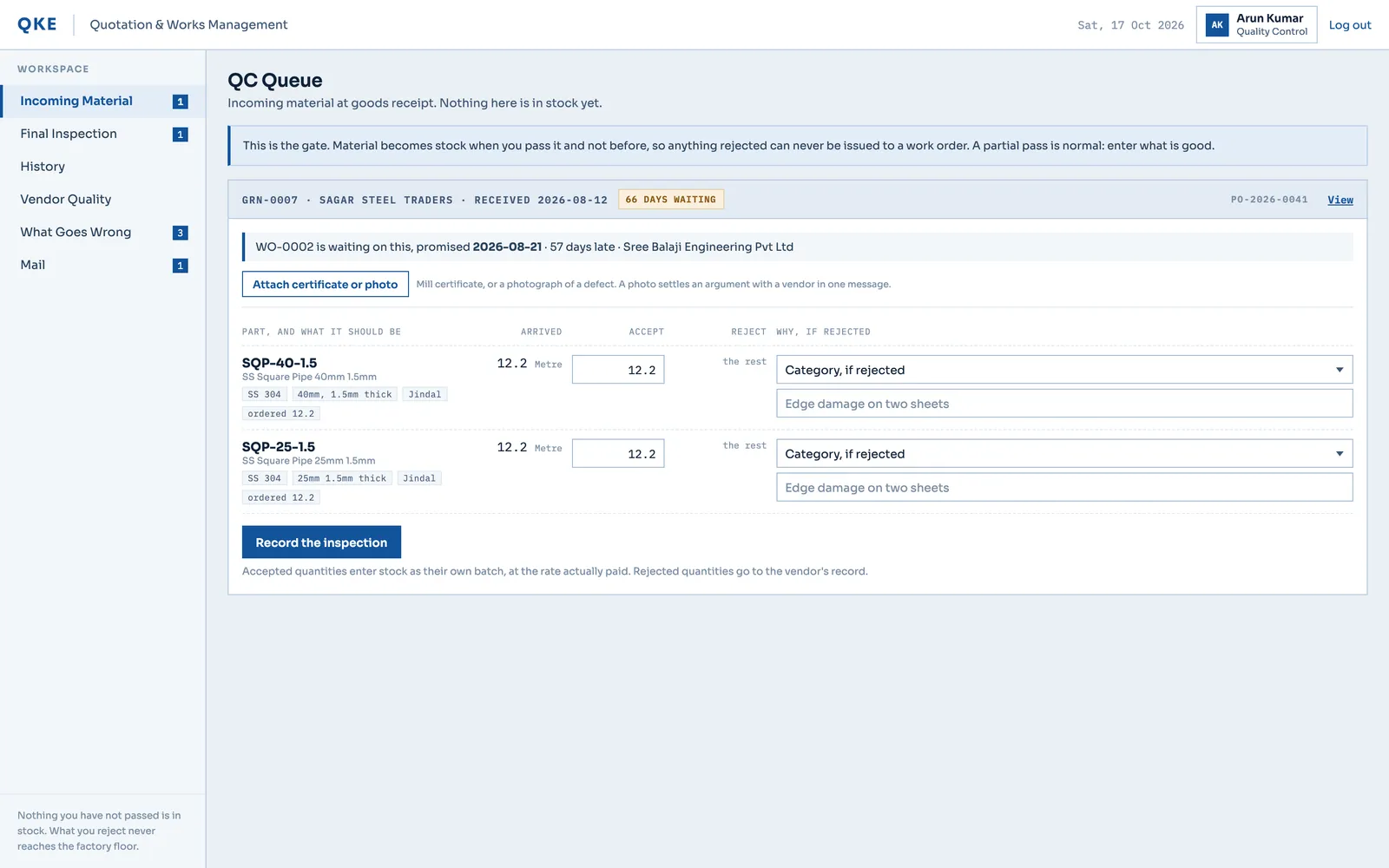
Prototype QC queue with a goods receipt awaiting inspection and accept/reject inputs per part.
Quality control is the gate at goods receipt: material becomes stock only when it passes, and rejected quantities are recorded against the vendor.
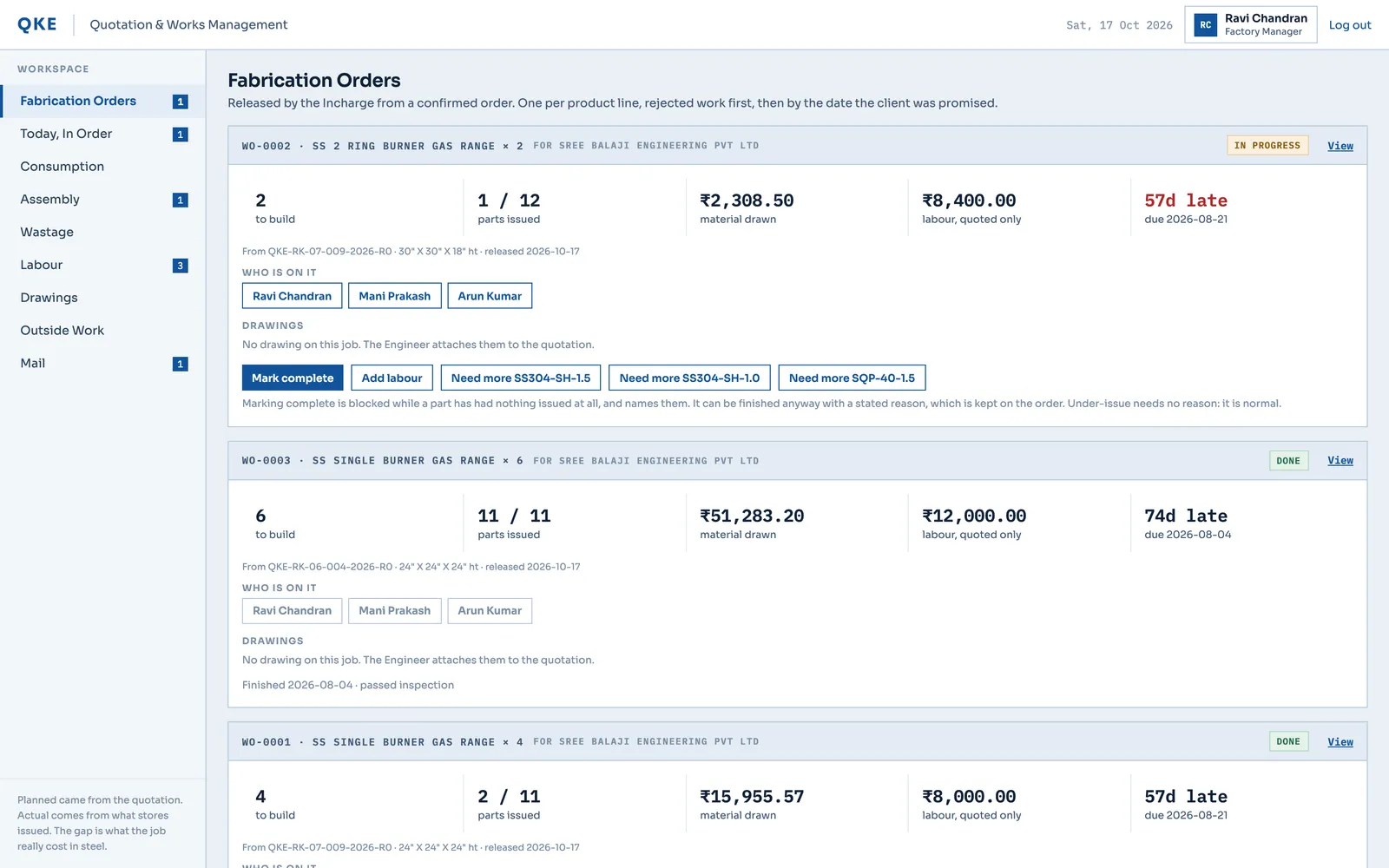
Prototype fabrication orders with parts issued, material drawn, labour and days-late figures.
The factory manager runs fabrication orders released from confirmed quotations, tracking parts issued, material drawn, labour and lateness.
Project details
Tech stack
Next.js 15React 18Redux ToolkitExpressMongoDB (Mongoose)PassportNodemailerHTML/JS prototype
Timeline & team
Aug–Sep 2026
FAQ

Questions about this project

How does the QKE system cost a fabricated kitchen product?

A product is never a fixed-price SKU. Its spec sheet is composed from reusable spec groups and parts, and its material cost is the sum of the parts it consumes; the margin is added on the quotation, not stored on the product.

How does the QKE design buy sheet metal for a work order?

The requirement is netted against stock, then rounded up to whole stock units such as full sheets, with the over-buy shown. Stock is then held as FIFO batches, each with its own rate, rather than one average price.

Which parts of the QKE system are built and which are prototype?

Authentication, the team panel, the role shell and the parts, product, vendor and part-detail masters are built in the real Next.js and Express app. The rest of the workflow, from quotation approval to stores, is an HTML prototype the build follows.

More work

Other things we shipped

All projects
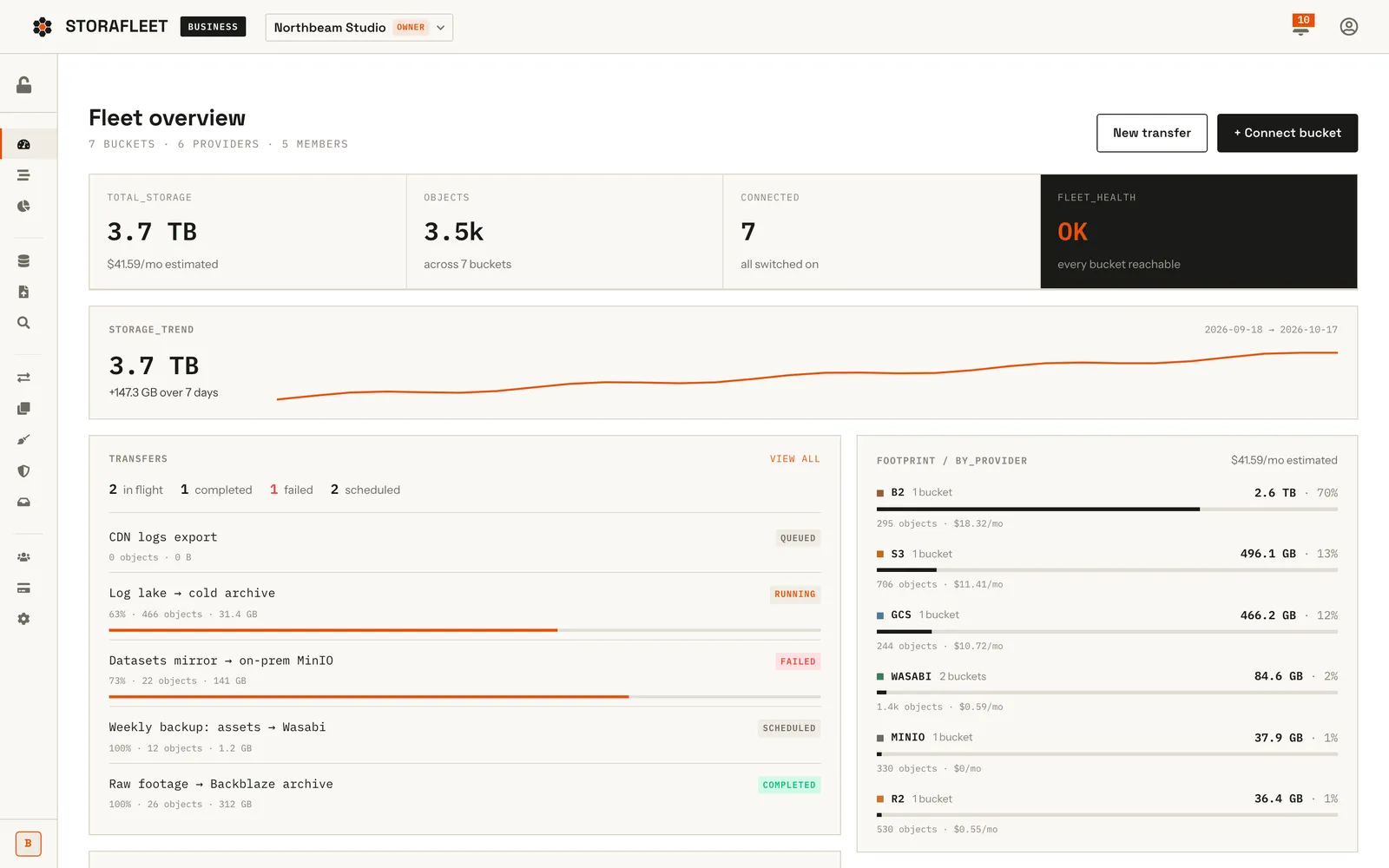
Storafleet fleet overview with storage totals, trend line, transfers list and per-provider footprint barsFeatured
Saasfor Storafleet

Storafleet — Multi-Cloud Storage Control Plane

Storafleet is CountryDevs' own SaaS control plane for object storage. Teams connect buckets they already own on 50+ providers, including AWS S3, Cloudflare R2, Backblaze B2, Wasabi and MinIO, then browse, migrate, search, secure and cost-check them from one console.

Next.js 15ReactRedux ToolkitNode.js+11
50+Storage providers in the connection roster
Case study
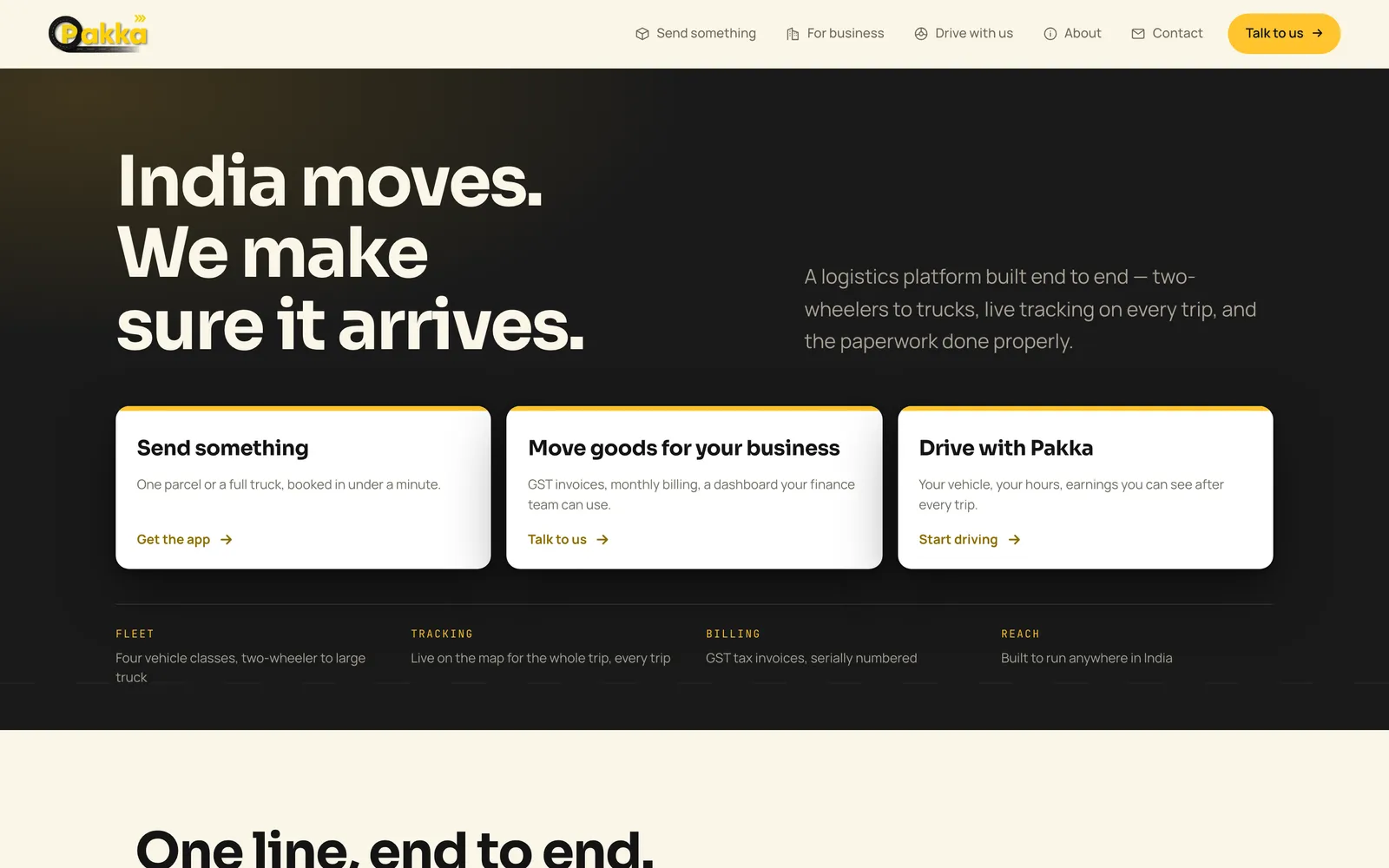
Pakka Logistics home page hero on desktopFeatured
Mobile Appfor Pakka Logistics

Pakka Logistics — Porter-Style Delivery Platform

Pakka Logistics is a Porter-style delivery platform for India. We built all of it: Android apps for customers and drivers, a business portal, an operations console and the website. The web platform is live; the Android apps are being prepared for Google Play.

React NativeTypeScriptRedux ToolkitNode.js+12
96.3%API routes exercised by a probe before launch (260 of 270)
Case study
Superadmin stories grid with photo storiesFeatured
Mobile Appfor Slic Solutions Private Limited

LetSlic — Social Media App with Group Chat, Stories and Premium

LetSlic, listed on Google Play as Slic, is a social app for photo posts, 24-hour stories and real-time chat with group moderation. We built it for Slic Solutions Private Limited: the React Native app, two Node.js APIs, the superadmin console and the website, plus Premium and ads.

React NativeTypeScriptReduxNode.js+13
13Months from first commit to handover (Jun 2025 – Jul 2026)
Case study
Got a project?

Let's build the
next one together

Tell us what you're trying to ship. We'll come back with a scope, a timeline, and a fixed price — usually within 48 hours.

Not ready for a full build? Start with a fixed-price Discovery Sprint, or get a code audit of an app someone else built.