
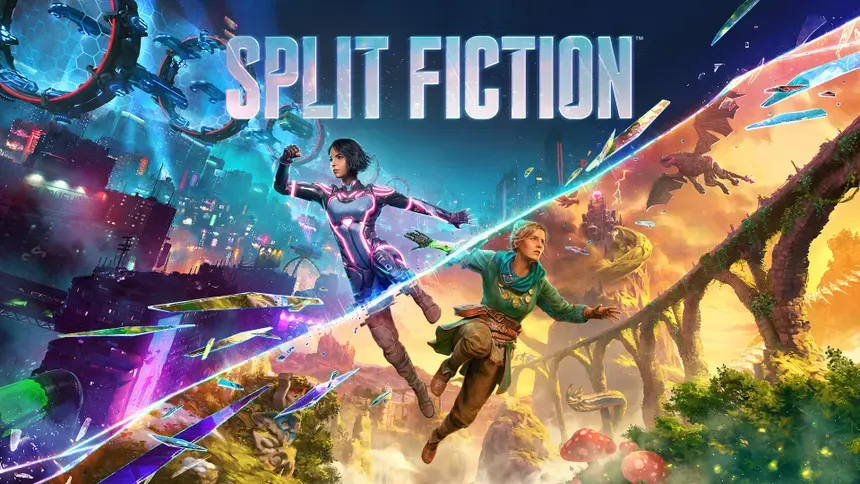
A completely spoiler-free co-op review, written by a guy who's been gaming for 25 years and his wife, who very much has not.
Let me start with the only sentence that really matters: my wife and I just finished Split Fiction on PS5, and we had an absolute blast.
Not "yeah it was good" blast. Not "we finished it, that's an achievement" blast. I mean the kind where you look up from the couch, realize it's way past midnight, and one of you says "okay one more level" for the fourth time in a row.
We took roughly 10 days to finish it completely - and I want to be clear about what that means, because "10 days" sounds either impressive or lazy depending on who's reading. We were not playing all day. We'd get a few hours in each evening, sometimes less. So call it a comfortable, unhurried playthrough by two people with jobs and a life, one of whom needed to learn what the right stick does.
Before this, the only game my wife had ever played with me was It Takes Two. We had an amazing time with that one, so when a new game from the same creators showed up, it was less a decision and more an inevitability. We knew what we were signing up for.
What we did not know is how much bigger this thing was going to be.
The jump from It Takes Two to Split Fiction is way bigger than I expected
I went in expecting a sequel-shaped experience. Same team, same co-op DNA, slightly nicer visuals, a few new ideas. A comfortable upgrade.
That is not what happened.
Split Fiction has massively levelled up from It Takes Two, and it's not subtle. It's the kind of leap where you finish the first proper level and immediately go "okay, so they were holding back last time."
The graphics are significantly better. And I don't mean "resolution number went up" better - I mean the worlds have a density and a confidence to them that the previous game didn't. Environments feel built rather than assembled. Lighting does actual work. There were multiple moments where we just stopped moving our characters and let the camera sit for a second, because the view genuinely deserved it.
The physics feel like they've had a proper upgrade too. Things move with more weight. Momentum matters more. When you're flung, thrown, launched or dropped, your brain believes it in a way it didn't quite before.
And the gameplay itself has evolved, the moment-to-moment stuff, the traversal, the way the two players are constantly being handed different toys and told to figure each other out. It's tighter. It's more demanding. It asks more of you, and it trusts you to keep up.
The visuals are, in a word, stunning. I don't throw that word around. I've been playing games for over 25 years, I've seen plenty of "stunning" that was really just "shiny." This is the real one.
The creativity is the actual headline
Here's the thing I keep coming back to, and honestly it's the reason I wanted to write this review at all.
The creativity blew our minds on a daily basis!!
Level after level, there is incredible variety. And I want to stress how rare that is. Most games, even great ones find a good idea and then politely ask you to do it forty more times with slightly different wallpaper. Split Fiction does the opposite. It finds a good idea, lets you enjoy it for exactly as long as it deserves, and then throws it away and hands you something else entirely.
Nowhere did we feel it got repetitive or boring. Not once across the whole run. That is genuinely remarkable for a game of this length.
Now, let me be honest, because I don't want this to read like a hype piece: there is a template. As you progress, you start to recognize the rhythm of it, the general shape of how a chapter opens, escalates and resolves. If you've played the studio's previous work, you'll spot the structure fairly early.
But here's why that doesn't matter: knowing the shape of the box tells you absolutely nothing about what's inside it. The game keeps throwing surprises at you one turn after another, and every single time you think you've got its number, it produces something you did not see coming. Even towards the very end, when most games are coasting on goodwill and setting up the finale, Split Fiction still had things in store for us. We were still being surprised in the final stretch. That basically never happens.
I don't think I have ever said so many "woooowwww"s in a single game. Out loud. Repeatedly. Like an idiot. And I've been doing this for 25 years.
Playing co-op with a partner who isn't a gamer
This is the section I most wanted to write, because it's the one nobody covers properly, and it's the exact thing couples are actually googling before they buy.
My wife is not a big-time gamer. Split Fiction is only the second game she's ever played. So going in, the honest question wasn't "is this game good", it was "is this going to be fun for her, or is this going to be forty hours of me watching her get frustrated?"
The real answer is somewhere in the middle, and it lands much closer to "fun" than I expected.
The difficulty for her was never about understanding the game. She got the ideas immediately, the puzzles, the logic, what we needed to do, sometimes faster than I did. The difficulty was muscular coordination with the controller. Getting fingers to do the right thing at the right time, especially on sections where you're asked to focus on multiple things at once and press multiple buttons in the correct order, over and over, under pressure.
That's a real barrier, and I'd be lying if I said the game gently accommodates it. It doesn't. There are sequences that demand precision, and precision is exactly the thing a newer player hasn't built yet.
But, and this is the important part, that shared struggle is what made the whole experience special. Because Split Fiction is genuinely co-operative. Not "two people in the same level." Actually co-operative, where neither of you can progress without the other doing their half properly. Which means when you're stuck, you're stuck together, and you have to talk it out.
So you end up in this loop: fail, laugh, argue slightly, re-plan, coordinate the timing out loud like air traffic control, fail again, and then absolutely nail it and both start yelling. Then a boss goes down and you high-five like you've achieved something in real life.
That's the bonding. That's the actual product here. The game is a co-op platformer, but what you're really buying is a very good excuse to solve problems with someone you love.
And to be clear, I found plenty of it challenging too. Some levels are properly thought-provoking, and a few made me sit back and genuinely work out what the game was asking of me. This isn't a game that's hard for the new player and trivial for the veteran. It's demanding for both, just in different places.
The honest bits
A review where the guy loves everything is not a review, it's an advertisement. So:
It is not a forgiving game for a brand-new player. If your partner has never held a controller, expect a learning curve, and expect to be patient. Some sections will take several attempts. If you're the type to get visibly annoyed when someone else is struggling, work on that before you start, because your attitude in those moments will define whether they enjoy this or quietly decide gaming isn't for them.
The structure is predictable even when the content isn't. You'll clock the pattern. It doesn't hurt the experience, but it's there.
You need two people, and you need them to both be up for it. This isn't a game you can grind out alone on a night when your partner's tired. Scheduling is a real part of owning this game. Our 10 days were 10 evenings we both showed up for.
None of that changed the score for us. But you should know it going in.
The Verdict
⭐ 9.5 / 10 - Play it with someone you love
Split Fiction is the best co-op game we've ever played together, and one of the most relentlessly creative games I've played in 25 years of gaming. It's a huge leap over It Takes Two in visuals, physics and ambition, it refuses to get repetitive, and it keeps surprising you right through to the end. The precision demands can be tough on a non-gamer partner, but overcoming them together is genuinely the point.
Best for: couples, siblings, best friends, and anyone who wants to actually play with someone instead of next to them.
Roughly: ~10 relaxed evenings to finish completely.
Quick answers to the things people actually ask
Is Split Fiction good for couples?
It's outstanding for couples. It's built from the ground up for two players who have to genuinely cooperate, and the shared problem-solving is the best part of it. If you and your partner enjoyed It Takes Two, this is a straight upgrade.
Can my partner play it if they've never really gamed before?
Yes, with a caveat. They'll understand the game fine, the challenge is controller coordination, not comprehension. Expect some tough sections and be patient. My wife had played exactly one game before this and we finished it completely.
How long does Split Fiction take to beat?
For us, around 10 days playing a few hours most evenings, finishing everything. Your mileage will vary a lot depending on how quickly both players click with the controls.
Do I need to play It Takes Two first?
No. They're unrelated stories. But if you played and loved It Takes Two, you're going to love this more.
Is it better than It Takes Two?
For us, comfortably yes, better visuals, better physics, better gameplay, and significantly more creative variety.
Can you play it single player?
No. It's a two-player experience by design, and honestly that's the whole appeal.
One last thought, from the day-job side of my brain
I build software for a living. That's what we do at Country Devs, we design and ship products for other people.
And the thing that stuck with me about Split Fiction, long after the credits, wasn't a level or a boss. It was the discipline of it. Somebody on that team made the call, over and over, to throw away a perfectly good mechanic after twenty minutes rather than stretch it to fill an hour. Somebody kept asking "is this still surprising?" and was willing to hear no.
That is an incredibly hard thing to do. In software, the cheap move is always to reuse the thing that already works, ship the padding, let the user get bored quietly. Nobody complains loudly about boring. They just stop opening the app.
So watching a team refuse to ever be boring, for an entire game, all the way to the final stretch, was genuinely inspiring to me as a builder. It's the same instinct we try to hold onto: care about the twentieth screen as much as the first one, and never let "good enough" be the reason someone stops paying attention.
Anyway. Go buy it. Play it with someone you love. Say "woooowwww" out loud with no shame whatsoever.
We did, constantly, for 10 days.
Played on PS5, finished completely, co-op throughout. Reviewed by Mayur Srivatsav, Co founder & CEO at CountryDevs.